
CRAFTED STORIES · CHRISTIAN CALLEJA GONZÁLEZ
@christiancalleja "Building systems that hold the image"

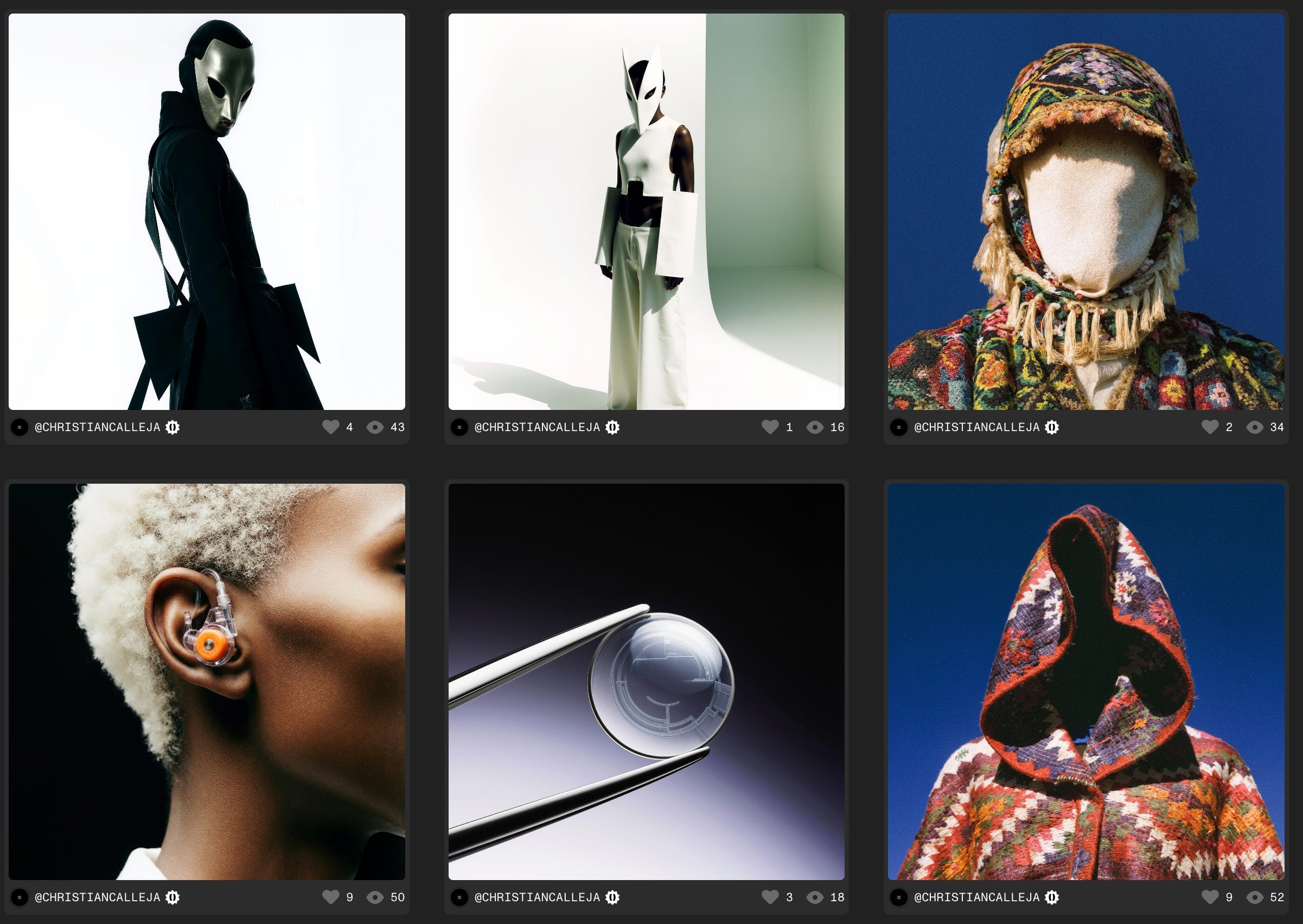
Christian’s relationship with MITO began before it had a finished shape. Back then, it felt like an initiative with a clear ambition: give creators real visibility and build an honest space for inspiration, with the noise stripped out. He followed from the start. The newsletter became a quiet constant, a stream of references and learning that actually rewarded attention.
For him, the arrival of MITO Universe was not a pivot. It was the next logical step. A place to share work with calm, to connect with people who carry similar sensitivity, and to grow inside an environment that treats participation as culture, not as a metric. He has been working with generative AI for almost four years. Still, he had not seen a platform put this much focus on visibility, community, and collective growth.
Universe does something subtle, “It raises your standards” he says.
WHAT HIS WORK EVOKES, FOT THOSE WHO HAVE NEVER MET IT


Christian’s portfolio looks diverse at first glance. Portraiture, product, fashion, macro, documentary light, studio black. Then the pattern reveals itself: an obsession with the point where an image stops being “a picture” and becomes a system of meaning.
Two impulses run through the work, almost in dialogue. One is tactile and human: skin, fabric, folk pattern, grass, age, the gravity of lived faces. The other is engineered: mechanisms, optics, industrial surfaces, precision objects held like evidence. He moves between them with the same discipline, as if the real subject is not genre, but control.
There is a recurring fascination with the interface. Mask as identity technology. A hearing device as a small future embedded in flesh. A lens held in tweezers like a relic of perception. A rope knot and carabiner framed as choreography. Even when the frame is quiet, it carries premise. The image feels cinematic because it is structured like a thought.
What ties everything together is how he treats detail. Close ups behave like arguments. Textures become narrative. Materials carry ideology. The frames ask the viewer to read, not just look. Variety lives on the surface. Rigor is the constant.
NARRATIVE FIRST, CURATION AS A HABIT
Christian begins with story. Always.
Curation, for him, is not decoration. It is training the eye, building a personal visual archive, defining a clear art direction, and deciding what the viewer should feel when they meet the piece. The image is never the goal. The image is the consequence.
When the concept is strong enough, the frame speaks on its own, but it speaks with intention.
That is also why MITO fits his process. Because MITO rewards systems. It rewards decisions. It respects the fact that craft lives before the render.
THE MOMENT IT CLICKED
During the Christmas period, Christian became one of the first to test the tool. He knew immediately it was a game changer. Until then, his workflow depended on stitching together different platforms, each with its own logic. The result was familiar: friction, disorder, and focus leaking out between tabs.
MITO introduced something deceptively simple. Order.
IN his case, is not a productivity trick but the condition that lets narrative stay intact.
In Christian’s workflow, MITO functions as an end to end environment. Image and video creation live together. Iteration stays agile. Control stays in the hands of the creator.
The shift becomes visible in three places: visual consistency, narrative clarity, and speed.
A piece like Lunar Lake, developed during the test phase, becomes his shorthand for what changes when the entire process lives in one coherent space. The work stops fragmenting. The direction holds. Decisions accumulate instead of scattering.
THE RIGOR LAYER
For Christian, MITO “does not replace judgment but asks for it”.
It pushes the creator to think in production terms, to make more conscious decisions, and to build systems and worlds.
In a landscape where AI risks flattening visual language into sameness, Christian sees MITO introducing something rarer: a layer of rigor that makes the difference. The tool requires taste. It requires structure. It requires you to know what you are doing, because it amplifies whatever you bring into it.
That is the point.
VISIBILITY AND SERIOUS TALENT
Universe, for Christian, has also been visibility in the only form that matters: connection with the right people he needed to connect.
By sharing work there, he has met creators with serious talent. He has received messages, feedback, and conversations that rarely happen elsewhere. That feeling of building something from within, with others who care about the same standards, is difficult to find. It changes how you show up. It changes what you consider “good enough.”
For Christian, MITO is a tool designed by and for creators with discernment. People who understand AI as craft, inside a wider filmmaking process. An environment that raises the level of the work, then asks you to meet it there.
Check more works from Chirstian here.