
CRAFTED STORIES · DELLAFUENTE FILM PROCESS
How we crafted and built Dellafuente’s ten‑year film and merch system in a single AI workflow that keeps the codes intact while accelerating production.

Welcome back to MITO Universe.
Crafted Stories is our ongoing publication series—an inside look at the making behind select MITO Films projects, and the craft decisions that shape them as they’re built inside MITO AI.
Some briefs arrive like a production schedule. This one arrived like a dare.
A LinkedIn message landed with a single premise: ten years of Azulejos de Corales. A merch drop to reopen the record’s visual life. Total creative freedom. Very little time.
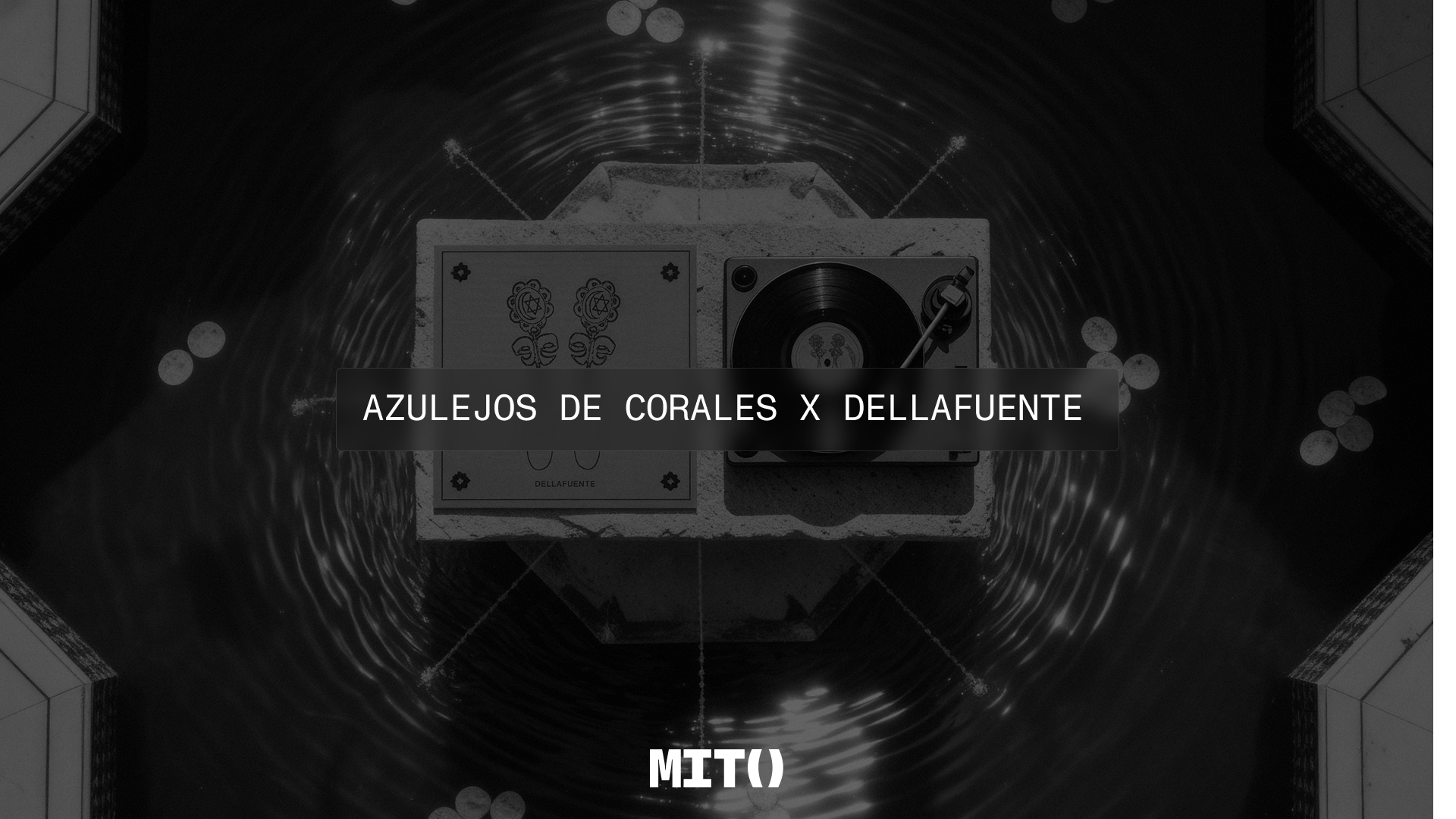
We were asked to mark the tenth anniversary of Azulejos de Corales by Dellafuente and relaunch its presence with a film that would carry a substantial merch drop. The brief needed one piece with enough gravity to reframe his visual codes and introduce the entire release in a single gesture. Full creative freedom. Tight timing.
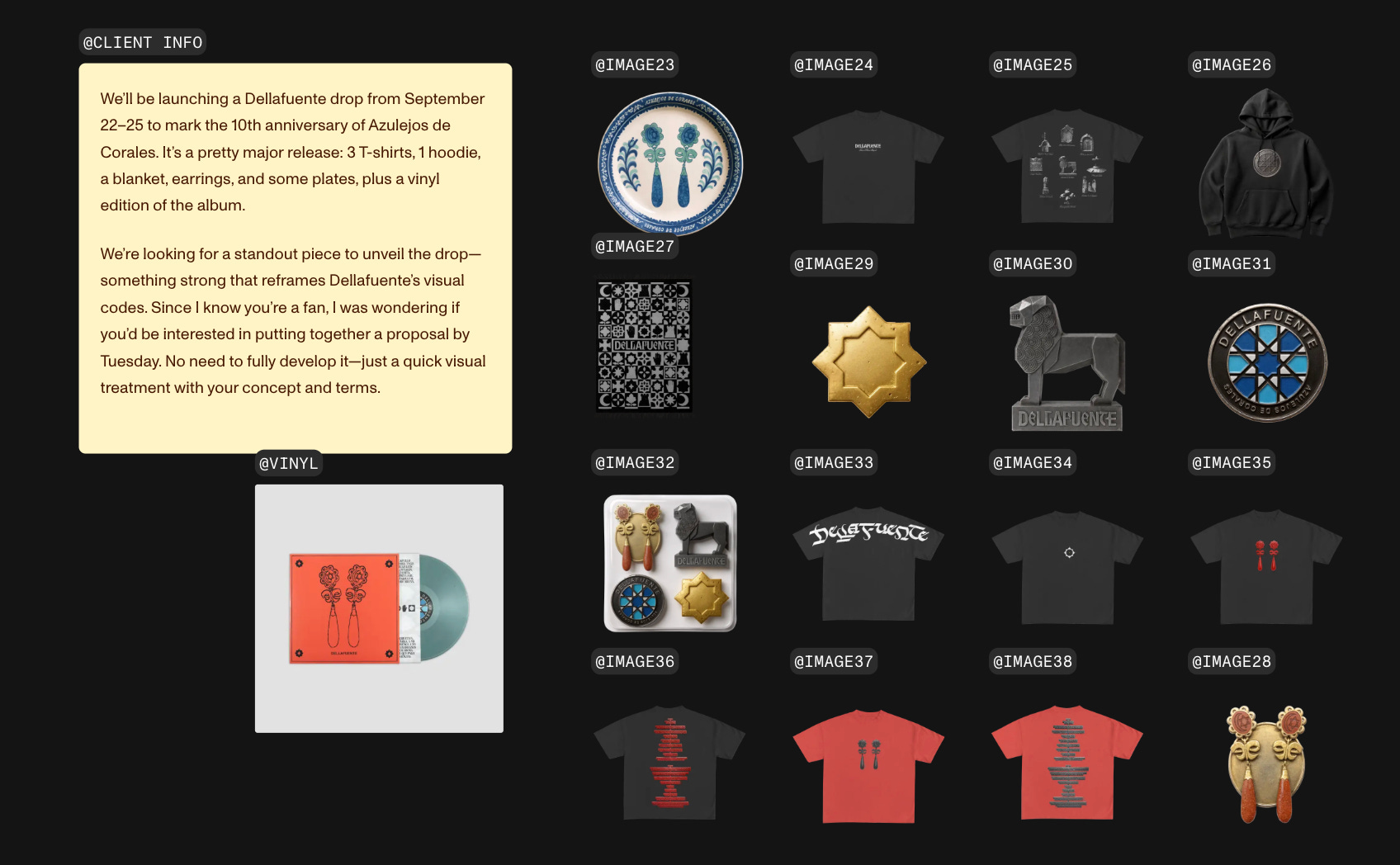
Three T-shirts, one hoodie, a blanket, earrings, small objects, plates, and a new vinyl edition. One film to hold them all.
SETTING THE FILE
We started by setting the file. Inside MITO, every asset lived on one canvas: the brief, past sleeves and clips, lyric notes, style guidelines, vector symbols, palette and type tests, and the full merch lineup. Research, writing, and early generation stayed on that same surface, so decisions could accumulate without drift.
RESEARCH AS DIRECTION
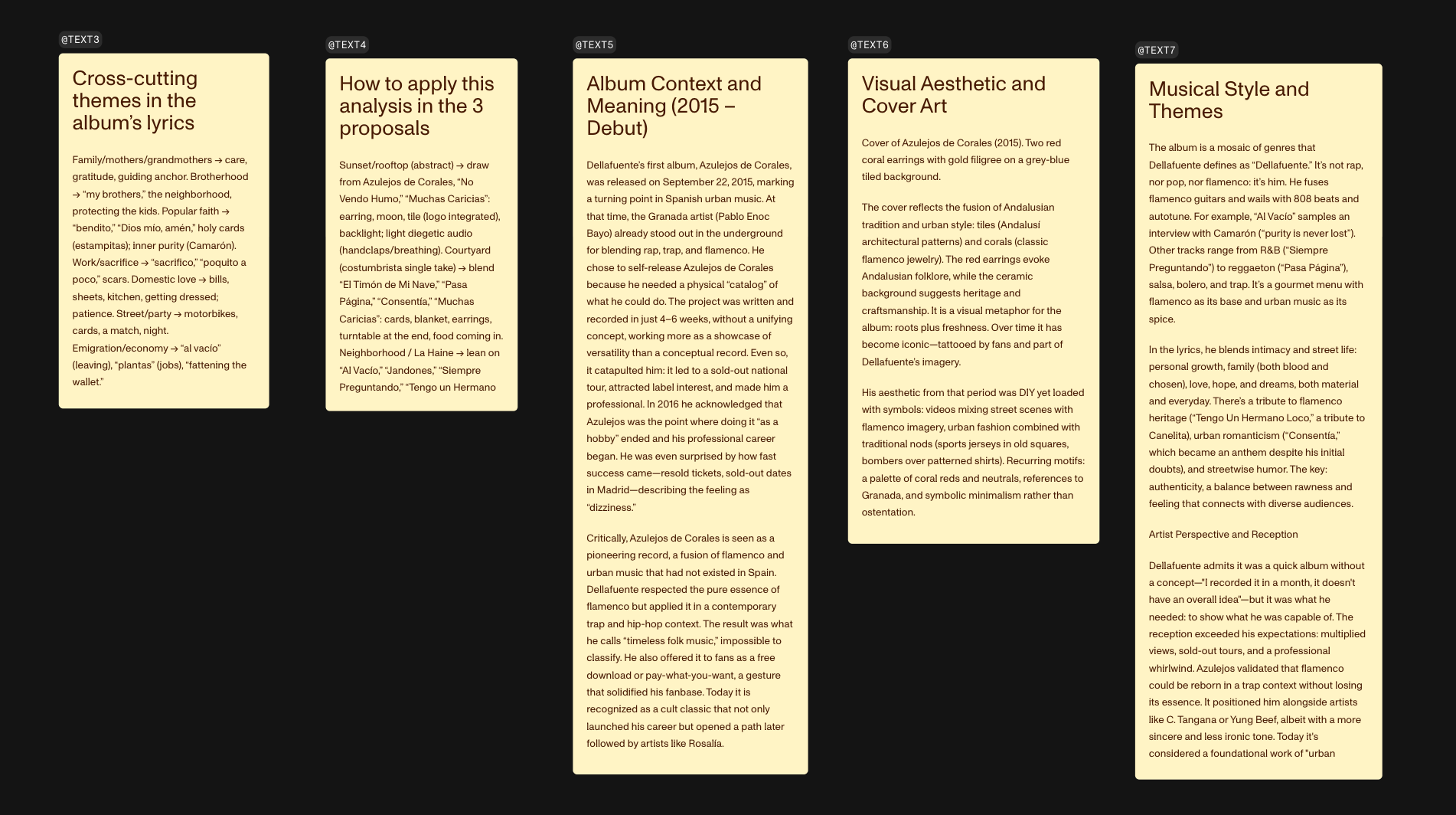
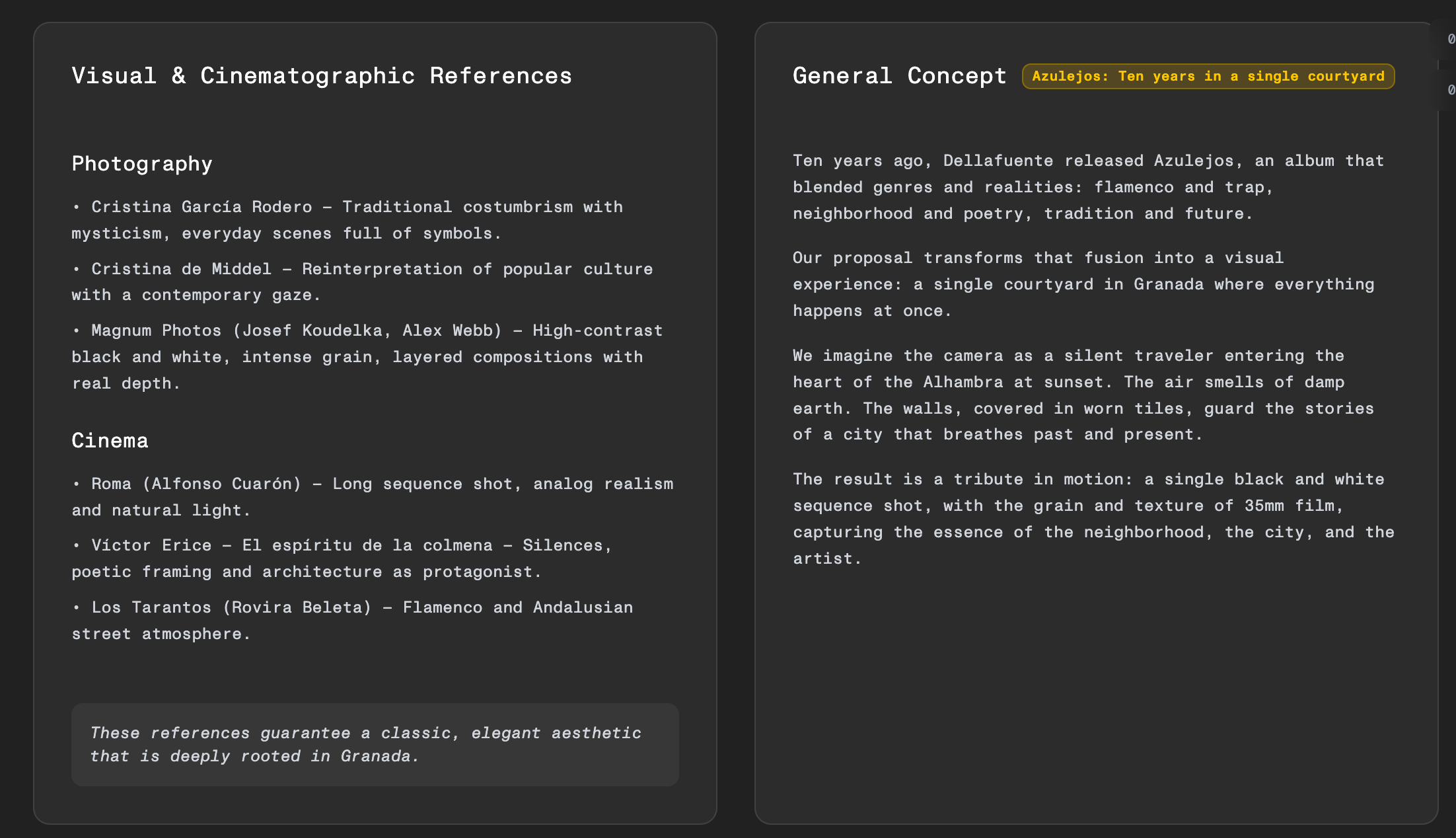
Dellafuente’s work is rooted in Granada. Tradition sits beside restrained electronics. The writing observes family and neighbourhood. His iconography returns to Nazarí geometry, stars, lunar signs—codes of belonging. That archive set the frame.
Direction began with research. We built the moodboard inside MITO: sleeves and clips re-watched, lyrics parsed, past campaigns and styling revisited. From there we translated themes into workable film grammar—objects, locations, textures, camera propositions. We mapped light, material and architecture, then generated the first stills to clarify the horizon and keep rights frictionless. The client recognised the territory and green-lit the path.
From that point, we stopped leaving the file. One operational sentence held the project together: ten years, same courtyard. The Alhambra wasn’t reference; it was a rule system. The courtyard became the operating logic—architecture that decides gesture, light, proportion, matter.
MOODBOARD AS WORLD-BUILDING
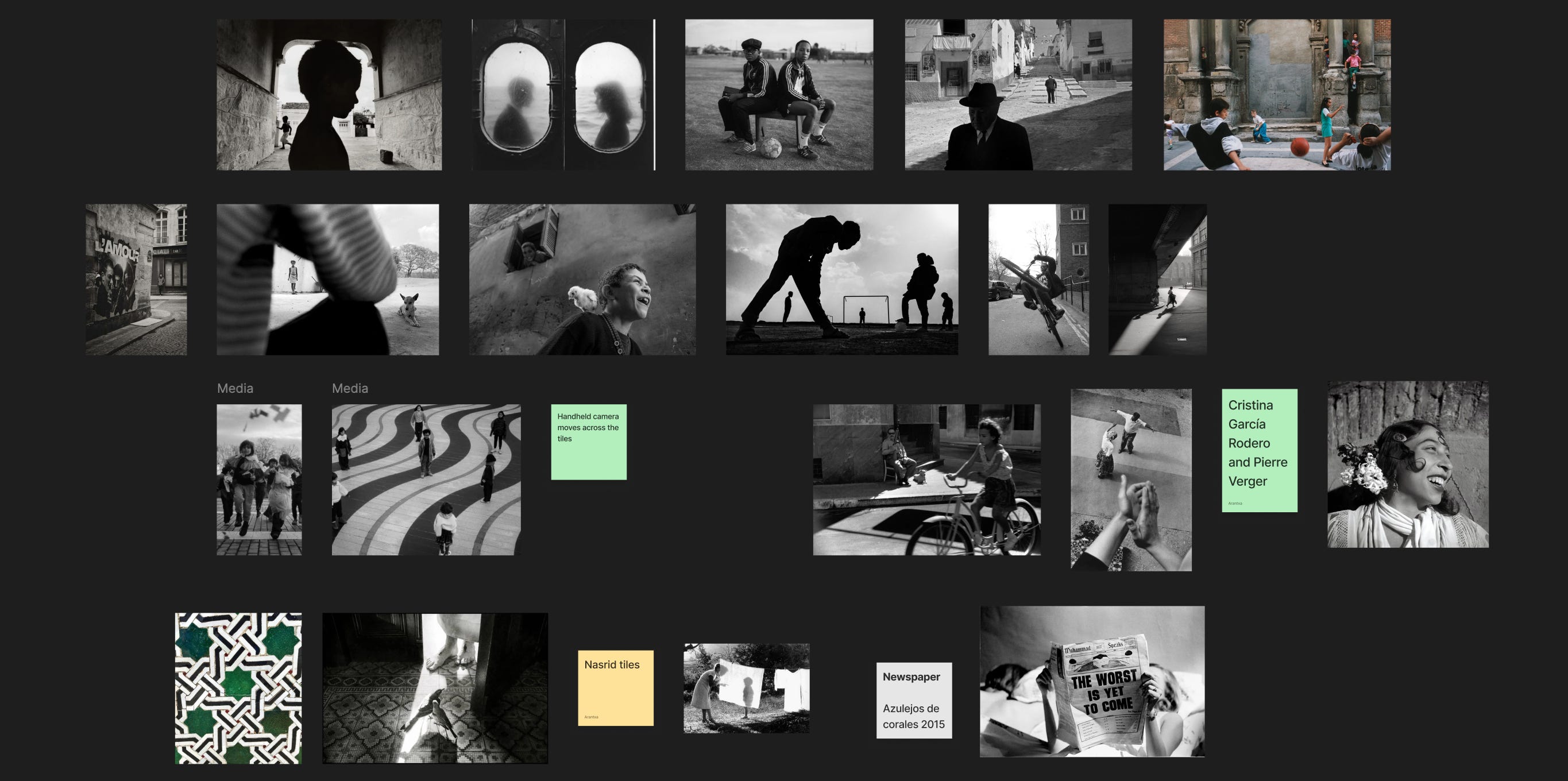
The moodboard stopped being a collage and became a world map built inside MITO. We combined real references from photography and cinema, including Cristina García Rodero and Pierre Verger, with stills generated by us to test the universe early and keep exploration rights-frictionless. Everything was organised as a system: the patio as architecture and grammar, materials as meaning, late light as a rule, and Nazarí motifs, geometry, stars and lunar signs as disciplined codes of belonging rather than decoration. The first stills made the direction immediately legible and turned approval into a simple test: does this belong to the patio or not.
CREATIVE PROPOSAL
One central idea: ten years, same courtyard. The courtyard acts as a fixed space with memory. The film treats it as ritual, not décor. Black and white collapses time; present gestures arrive with archival weight. The camera stays composed and observant. Movement appears only when intention calls for it. Objects carry jobs in frame—stone to measure, fabric to shelter, tile to mark, metal to reflect. Repetition builds permanence; slight variation signals lived time. Music sets pulse without dictating meaning. Identity holds because the rules hold: you can enter from many angles and still recognise the world.
SCRIPT AND STORYBOARD
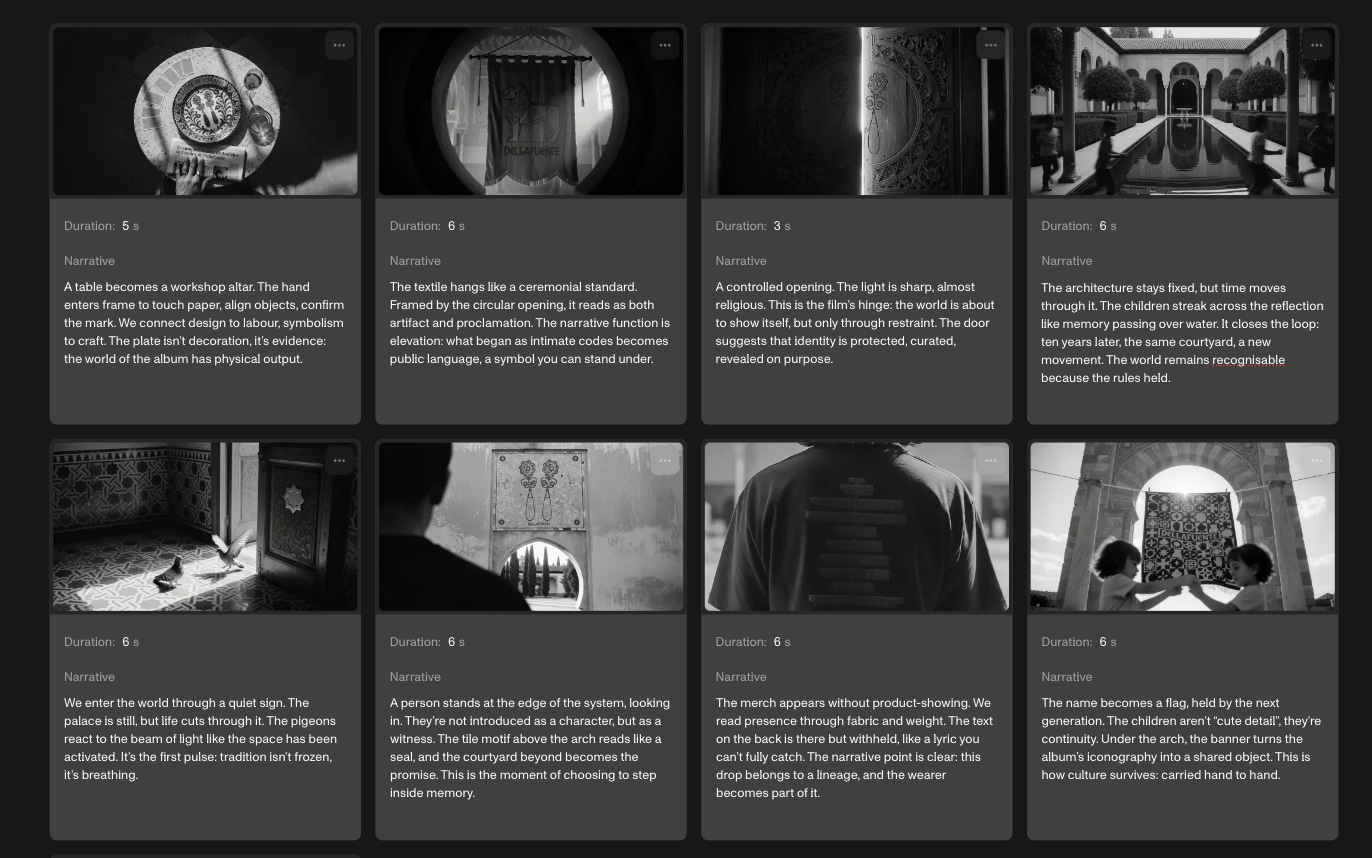
Once the world was approved, we wrote the film as beats, not shots. We wrote the script—scene by scene, second by second. Action, place, cast, the exact merch that breathes in each shot. Every beat became a frame that prefigures the film. The storyboard consolidated the contract: representative image, description, camera position, light behaviour. Clear agreement between intention and execution.
PRODUCTION SYSTEM
With approval on the table, production followed. We generated the clips in MITO and integrated the appropriate video models. Coherence held across shots: the same character persists, the same location stays consistent, palette and texture remain stable where space is shared. The edit favoured rhythm and legibility.
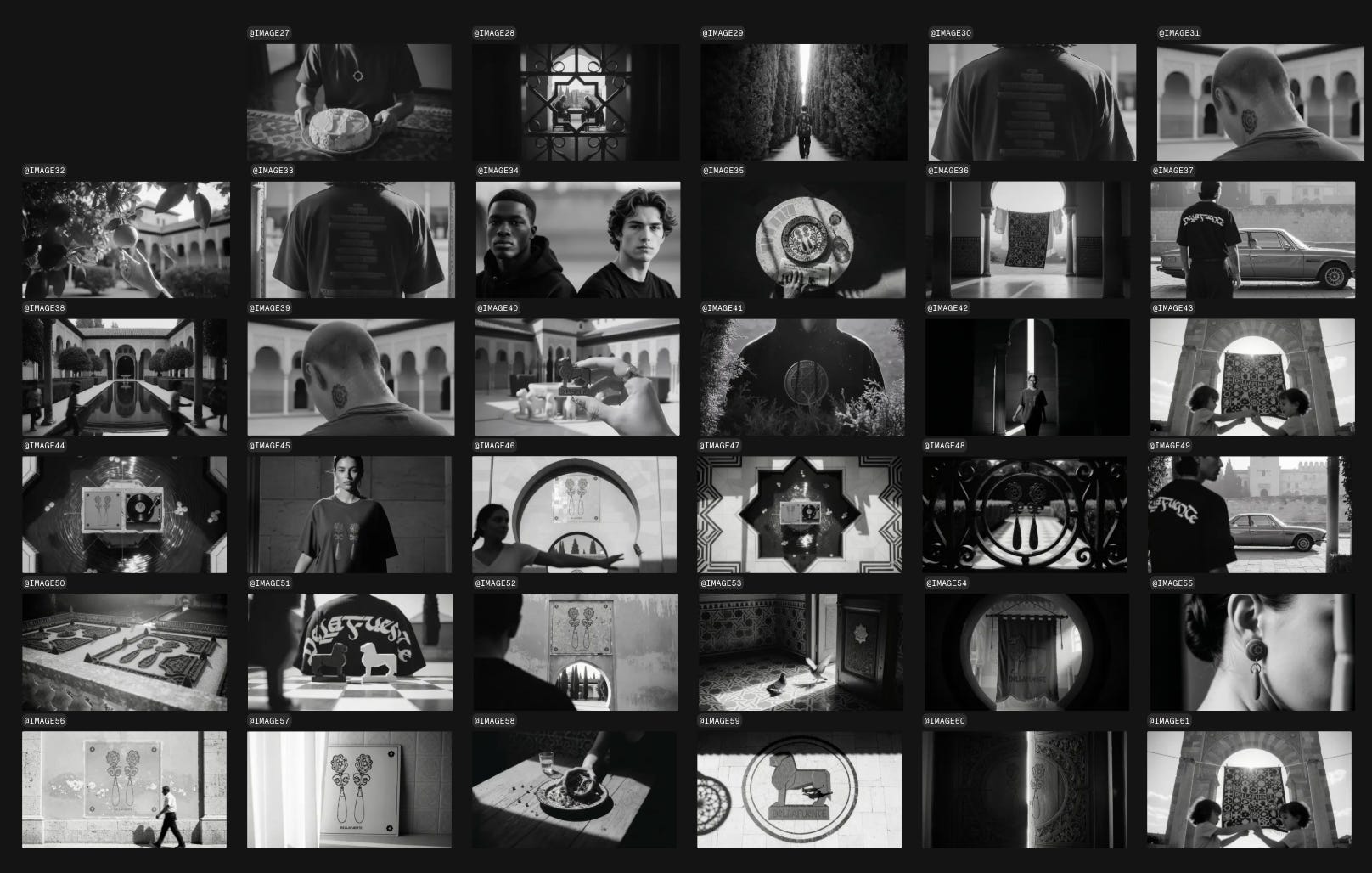
Then we worked product by product inside MITO. Each SKU received its own lane before image production: keychain, vinyl, tees, hoodie, blanket, pins, plates. For every item we defined its role in the film, its hero moment, and how it behaves in frame. We tested how a logo sits on cloth, how metal catches late light, how tile patterns hold close focus. That pass gave generation clean context: what appears, where it appears, and under which conditions it stays true. The storyboard inherited those decisions and kept them stable across scenes.
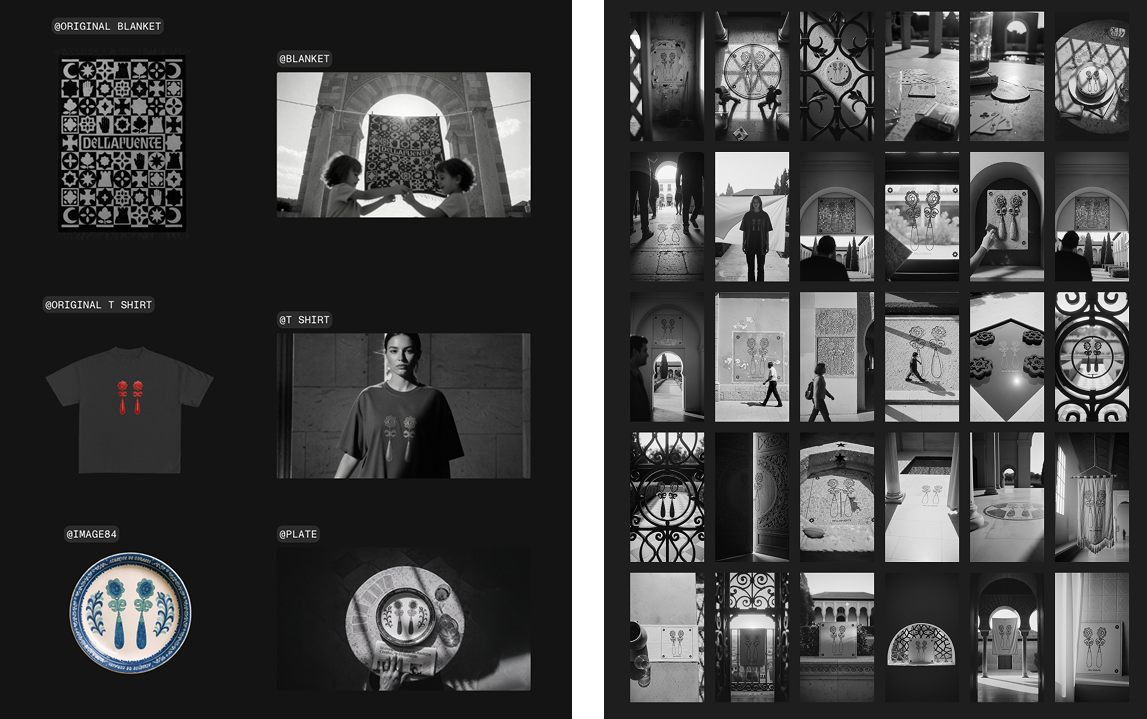
Symbolism and craft run through the film without ornament. Monochrome pulls attention toward matter and gesture. A rhythmic score sustains solemnity. The images carry an atemporal nostalgia—memory updating itself without losing root. Stone, fabric, tile become vehicles of identity in dialogue with contemporary design.
Textiles move like standards: fringe, iconographic embroidery, flowers and stars under the DELLAFUENTE name. Hands work plaster and stone; brushes reveal relief and texture. Mudéjar arches and mosaic floors fold design into architecture until the world is built from primary materials, not styling.
Cinematography leans on firm contrast. Natural light enters through arches and openings, sculpts worn surfaces, models relief, clarifies each object. Monochrome heightens roughness in stone, softness in cloth, precision in engraving. Composition uses symmetry and architectural frames to grant ceremonial presence.
The final shot opens a door. A blade of light enters. Workshop becomes apparition.
Technically, the backbone is perimeter control. MITO enforces a visual bible with operative rules: camera range, light logic, grain density, object semantics. Variants are evaluated against those rules and returned with context. The system keeps memory of versions, comments, approvals, and licenses on the same working surface. Consistency arrives through process, not late correction.
What stayed with us after this case: a visual universe gains force when symbol and use share stable rules. Criteria scales when conditions are explicit and deviation is measurable. Speed matters when it preserves the artist’s calligraphy. Same courtyard becomes a policy of continuity—structure carrying memory forward.
Creative direction and production: MITO Films x Arantxa Barcia
System and workflow: MITO AI
Artist: Dellafuente