
CRAFTED STORIES · Movistar World Cup
How We Built a National AI Manifesto for Movistar

How We Built a 120-Second National Manifesto for the Spanish National Team by Orchestrating an AI Ecosystem
This week, a commercial generated 95% with artificial intelligence aired in prime time across every major television channel in Spain. It was a 120-second World Cup campaign for the Spanish National Team and the Royal Spanish Football Federation (RFEF). To achieve something of this scale, the workload was monumental: we generated more than 5,130 assets in total (over 4,000 images and 800 videos), pushing through between 55 and 65 rounds of pure iteration. But the most fascinating part is not the numbers — it’s the intention: we wanted the AI to be noticeable on purpose. Due to the metareferential demands of our narrative, we pursued an “imperfect aesthetic,” to the point where we even considered giving characters extra fingers as an intentional machine flaw to make the artificial nature of the work explicit.
This is the story of how MITO, in collaboration with creative director Oriol Villar and production company ROMA, made it a reality.
1. Introduction: The Challenge of Humanizing the Machine
In orchestrating this visual system for Movistar and the RFEF, we faced an extremely high-stakes creative tension: how to use generative AI to produce a national manifesto that felt deeply human rather than synthetic or cold. The project revolved around “The Network” — the invisible infrastructure of connectivity that links fans, players, and the collective soul of a nation.
To bring this concept to life, we went beyond treating AI as a production shortcut and approached it as an industrialized craft. By managing a pipeline of more than 5,000 assets, our goal was to define an operational logic in which technology served as a symbolic language, illustrating that in Movistar’s world, everything and everyone is connected.
2. Brief: A Perfect 17-Year-Old Mistake
The core concept of the project revolved around “a network you can’t see,” an invisible force connecting all of Spain through football. However, the entire visual universe was justified through Tommy, a 17-year-old high school student creating a school project using artificial intelligence tools.
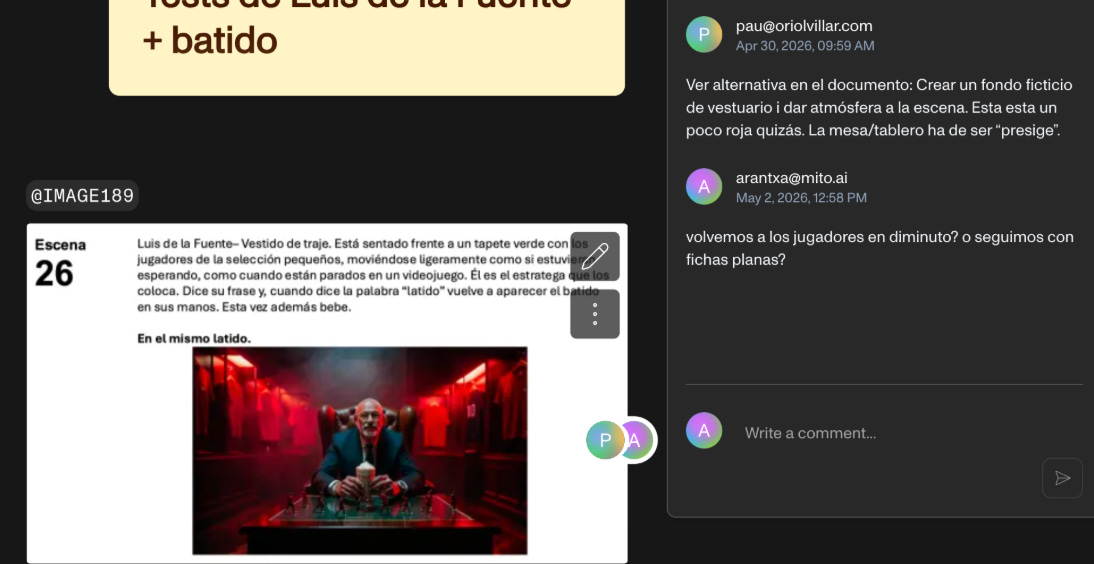
At the climax of the commercial, Spain’s national team coach, Luis de la Fuente, was supposed to deliver the final epic line. But the AI Tommy is using makes a mistake, and the coach says: “In the same milkshake,” while literally appearing with a milkshake in his hand. Tommy quickly corrects the prompt live on his computer, the AI recalculates, and the spot culminates with the powerful line: “In the same heartbeat.”
Tommy’s correction:
“De la Fuente has to say: ‘In the same heartbeat.’”
The AI application’s response:
“Much better. Now it’s going to feel way more powerful.”
By showing the dialogue between the creator and the tool, we shifted the narrative away from the idea of a “big production” and toward the “power of participation,” making the technology transparent and relatable for a digitally native generation. This narrative brilliance is what allowed us to embrace that Imperfect Aesthetic. We didn’t want hyperrealism that would deceive the audience; the artificial, plastic, and at times surreal nature of the images was at the very core of the story itself.
3.Embracing the “Imperfect Aesthetic”
Embracing the “Imperfect Aesthetic”
A core philosophy of the project was the explicit rejection of hyperrealism. We chose to implement an Imperfect Aesthetic where the AI is intentionally recognizable as AI. To ensure the audience perceived the synthetic nature of the images, we even considered strategic glitches — such as giving characters extra fingers — to push the aesthetic choice into the realm of metanarrative strategy.
The manifesto is built upon a visual bible of surreal and impossible connections:
Impossible geography: stadium stands carved into the irregular, rugged cliffs of Galicia.
Architectural hybridity: a neighborhood bar where every surface — from the beer taps to the ceiling — is entirely covered in stadium grass.
Lamine Yamal’s throne: the young football star seated on a throne of vibrating subwoofers in the middle of a street, holding a football like an imperial orb.
This aesthetic serves the metanarrative of the story, demonstrating that “The Network” can synthesize any reality into a single national “stadium.”
4. The MITO Process: How We Actually Produce From the Inside
Creating a commercial at this scale is not about writing magical prompts — it’s about directing a system. At MITO, the production model comes at the very end of the thinking process. Our internal workflow follows a strict structure:
1. Narrative Before Everything Else
AI does not improvise structure — it executes it. Every script is written with a clear understanding of what the model does well and what breaks it. If you don’t define an authorial tone within the text itself, the model simply defaults to the average of the internet.
2. Visual System and the Rule of 6
The entire ecosystem is organized within our interactive Canvas. To avoid confusing the machine, we use the “Rule of 6.” We define strict variables across 6 axes: World, Camera, Light, Texture, Actions, and Character. If you use more than 6 references per group, the model averages the result — and ruins it.
3. The Still Image Always Comes First
Before spending budget and time on animation, we validate the art direction through key frames. Video will always inherit the problems of the base image, which is why iterating in photography first is between 5 and 10 times cheaper and more effective.
4.The Real Scale: The Recursive Workflow
Our final direction Canvas looked flawless, with 1,441 assets perfectly connected in a network. But generative projects are like an iceberg. If we look at the recycle bin and the history of our system, the real volume rises to 5,130 generated assets created over the course of a month of work:
~4,085 images: used to test different “universes” and ensure character persistence across 29 specific scenes.
848 videos: generated clips that were rigorously evaluated against our visual bible.
189 documentation assets: scripts, storyboards, and frictionless rights-free style guides.
By keeping the brief, the research, and the generation process within the same surface, we maintained “perimeter control.” This prevented creative drift and ensured that the project’s technical codes remained stable as the production became industrialized.
To achieve the fluidity of the spot, we had to go through between 55 and 65 rounds of pure iteration:
Mónica Marchante: Integrating the journalist live through a mirror (and later onto a broadcast van) took more than 25 unique iterations to perfectly match her face, the crowd background, and the lower-third headline.
The Bear’s Climax: For the final shot of the bus, we went through more than five complete rounds of concept revisions—experimenting with green screens and a bear emerging from the hedges—until we finally discovered the visual magic.
5.AI Director
MITO.AI’s technical key to managing this chaos was our AI Director — an integrated copilot that absorbs the context of the brief and the references. It doesn’t function as an isolated chat, but rather as the project’s memory, allowing us to iterate while maintaining the invisible continuity of style, lighting, and brand personality.
6.Building a World of Impossible Connections
“The Network” functions as both a symbolic and structural device, using impossible architecture to build a bridge between anonymous fans and iconic figures. The film moves through spaces that should not exist, yet feel emotionally true:
Juanma Castaño and the Sand Coliseum:
One of the most demanding scenes involved placing journalist Juanma Castaño building a colossal sand stadium on San Lorenzo Beach in Gijón. At first, the model kept drifting toward Roman Empire-style stadiums or overly fantastical architectures. We had to iterate extensively until we found the right balance: it had to feel impressive, yet clearly built from wet sand. Beyond the enormous challenge of preserving the likeness of such a well-known public figure through dedicated casting sheets, the key visual detail of the shot was the prop design: replacing a construction shovel with a giant fluorescent yellow child’s rake, giving the scene that perfect touch of surrealism
The Olympic Pool:
Legendary swimmer Teresa Perales appears in a swimming pool where the edge of the water seamlessly blends into the grass and white chalk lines of a football pitch.
Ferran Adrià’s Foundry:
In the final version (scene 27), Ferran Adrià appears in a kitchen pouring molten gold into a football trophy-shaped mold. The scene was designed with a deep black palette, where the lighting is motivated solely by fire, and the only chromatic accent is the bright golden-orange glow of the molten metal, evoking the real process of gold casting. The shot involved a double challenge: on one hand, the legal challenge, since the mold and resulting trophy needed to clearly evoke the World Cup trophy without reproducing its exact form (a copyrighted design); on the other hand, the AI likeness challenge, because the model tended to generate the chef as bald, and we had to provide very specific instructions to preserve his characteristic white hair.
“It’s a network you can’t see, but it’s everywhere.”
AI allows us to collapse distance and discipline, placing everyone — from the traveler glimpsing stadium stands through a bus window to the elite athlete — within the “same play.”
Conclusion: The Future of Collaborative Storytelling
Delivering a 120-second campaign for a global event in record time proves that AI transforms production — but not the talent required to guide it. The Movistar manifesto stands as a testament to the future of culture: we have reached a point where the cold “perfection” of traditional media is losing ground to the authenticity of transparent AI-driven storytelling. By embracing the intentional glitch and the visible hand of the creator, we build worlds that feel more connected to human experience than any empty simulation ever could.
The future is not about hiding the machine; it is about showing how the machine helps us see one another.
As Oriol Villar pointed out during the process: “AI does not replace ideas, people, or emotion. But when used with sensitivity, judgment, and respect, it will help us discover new ways of imagining and telling stories.”
Same process, every time. Different playground.