
THE CURATED LOG XXVIII
By MITO Universe - @mito.universe

Welcome back to MITO Universe.
This week arrives at a moment when AI no longer announces itself as novelty, but as atmosphere. It hums beneath pop culture, institutions, and personal memory alike; sometimes loud, sometimes barely perceptible. Tools recap our past, residencies sketch future paths, and mass culture absorbs what once felt speculative. Yet beneath this acceleration, quieter questions persist: how to slow down, how to listen, how to shape meaning without excess.
The works featured here move through those tensions. They speak in restraint and ritual, in transformation rather than declaration. Between silence and distortion, surface and depth, they remind us that the most interesting futures are not built by noise, but by attention.
SELECTED CREATORS
The MITO Universe lives through the artists who move within it. Every week, we turn our attention to one of these voices; practitioners using AI with purpose, authorship, and precision.
If you’re constructing worlds, working thoughtfully, or contributing to the future of visual culture from the inside out, you belong here. Join the community, create your MITO Universe account, and enter the conversation.
MITO UNIVERSE CREATIVE SPOTLIGHT: Elsa Veen | @elsaveen


Elsa Veen is an Amsterdam-based visual storyteller working across design, fashion, and AI-assisted image making. Her practice unfolds in a quiet, disciplined register, where form is reduced to its essential tensions: softness against hardness, ephemerality against weight, the organic brushing up against the engineered. Flowers eclipse faces, metal bends like flesh, landscapes appear monumental yet emotionally distant. These images do not announce themselves; they withhold.
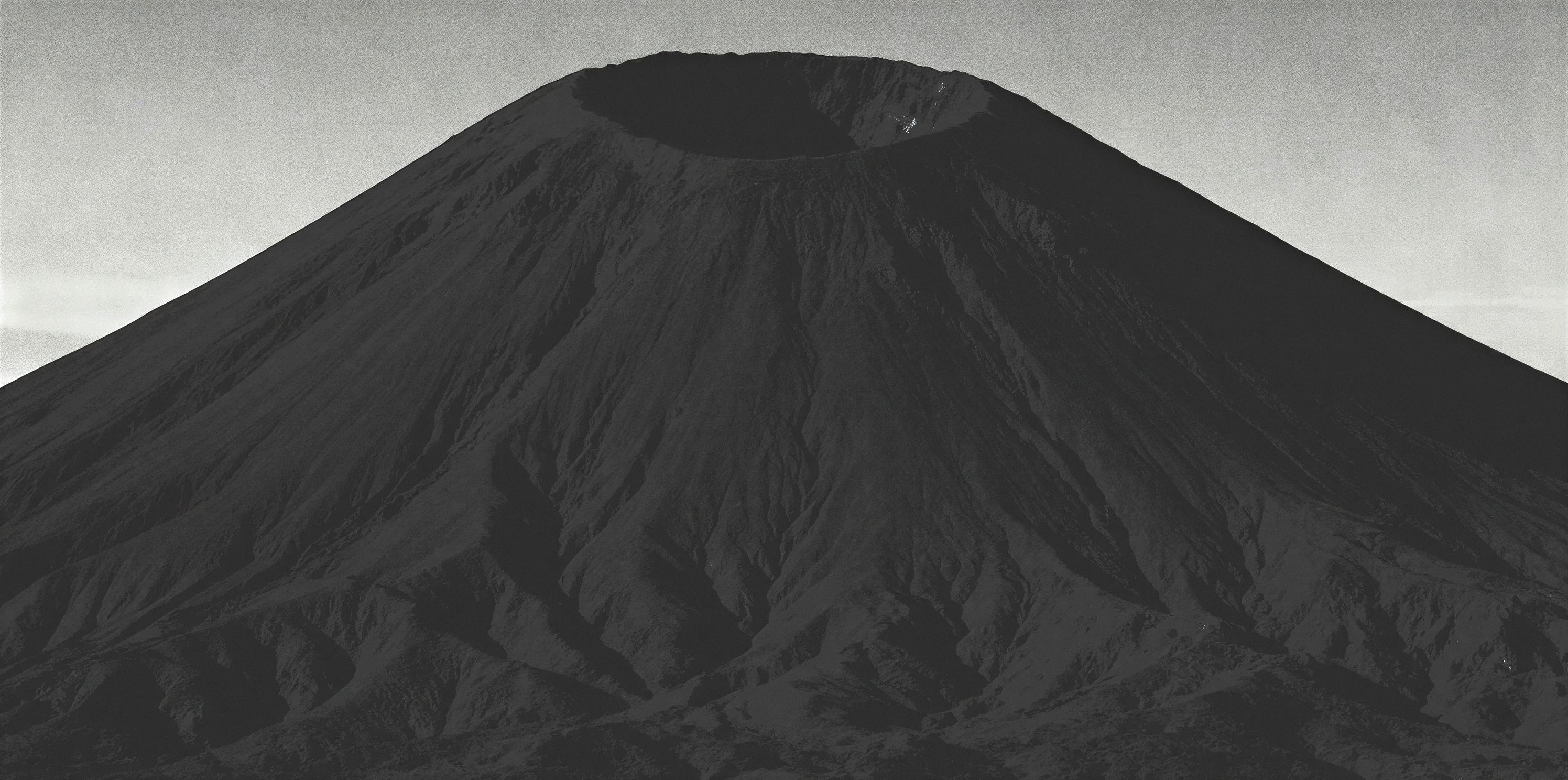


Veen’s work operates within a post-romantic sensibility, one that understands beauty as something structured, restrained, and slightly unreachable. AI is not used as a generator of excess but as a lens of refinement; a way to compress vision, to strip away noise, to arrive at archetypal forms. Her portraits feel devotional yet anonymous, as if identity were less important than presence. Objects become almost liturgical: sculptural vessels, twisted metals, and candle-like forms that suggest ritual without naming it.
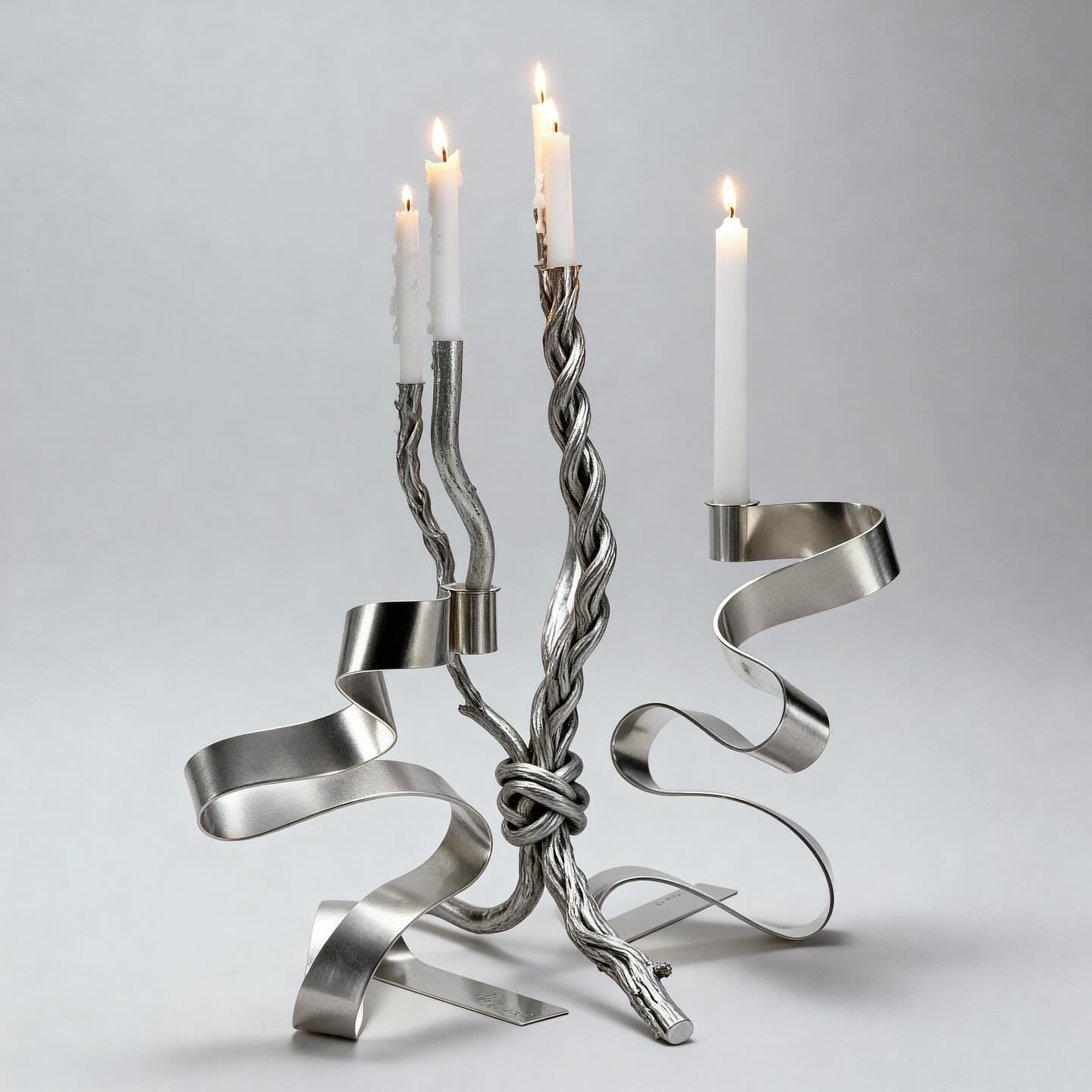
In her landscapes: icebergs, volcanic silhouettes, stone and shadow; nature is neither sublime nor comforting. It is neutral, immense, and impersonal. Veen positions the human sensibility not at the center, but at the margin, observing rather than conquering. Across fashion, design, and AI, her work proposes a poetics of restraint: an aesthetics of silence, where meaning emerges not through declaration, but through duration and stillness.
Arminda da Silva | @_____imaginethat
Arminda da Silva, a South African graphic designer and illustrator based in Johannesburg, operates in the fertile tension between tenderness and disturbance. Her work refuses the comfort of pure beauty; instead, it lingers in the threshold where the grotesque becomes expressive rather than repellent. “Weirdness,” for da Silva, is not an aesthetic quirk but a methodological stance; a way of resisting polished legibility and reopening images to uncertainty, affect, and myth.
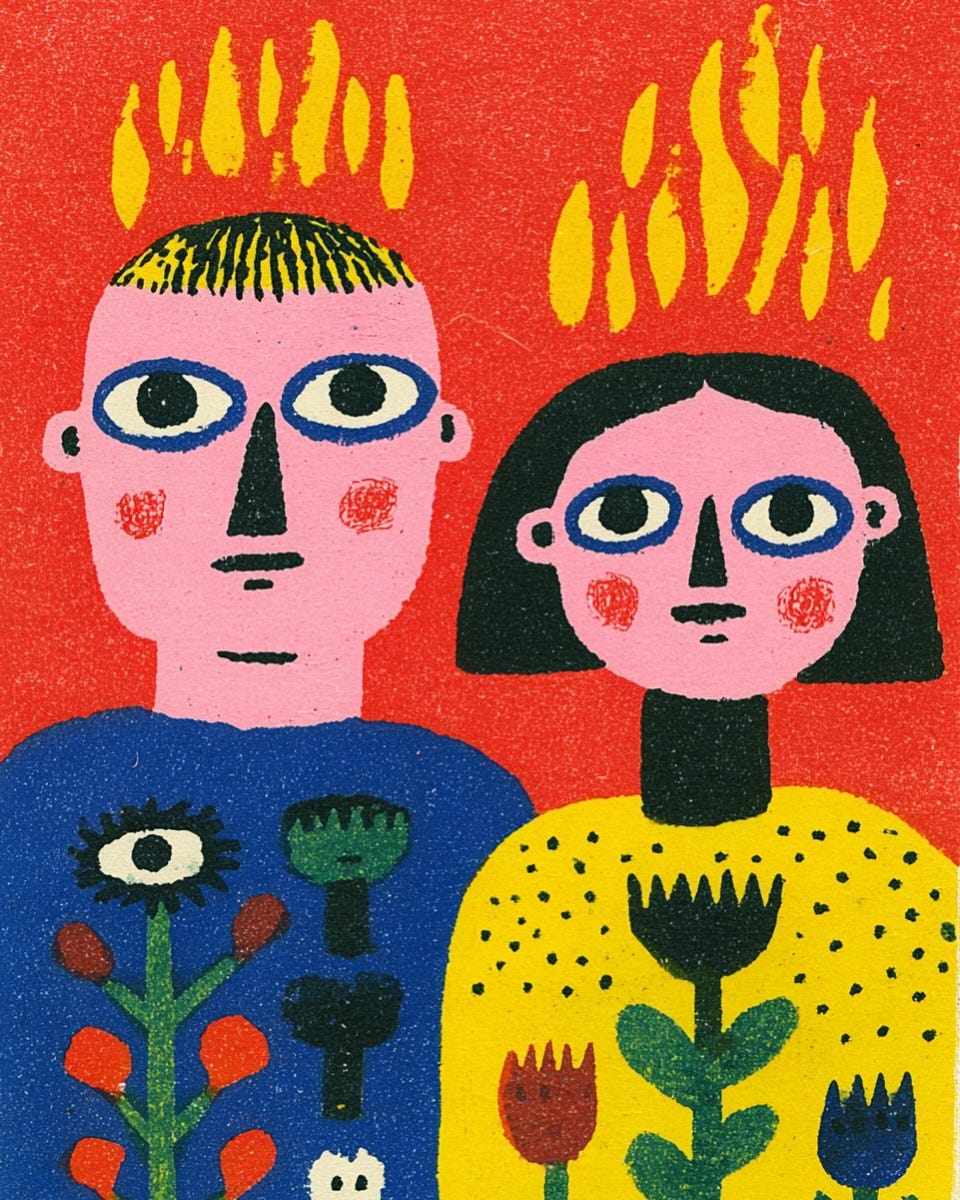


Her AI-generated figures appear ritualistic: houses grow faces, bodies become architectures, flames crown heads like unstable halos. These forms feel handcrafted despite their computational origin, echoing beadwork, folk sculpture, and vernacular craft traditions while remaining resolutely synthetic. The result is a visual language that oscillates between play and unease, humor and dread; an art that smiles while baring its teeth.
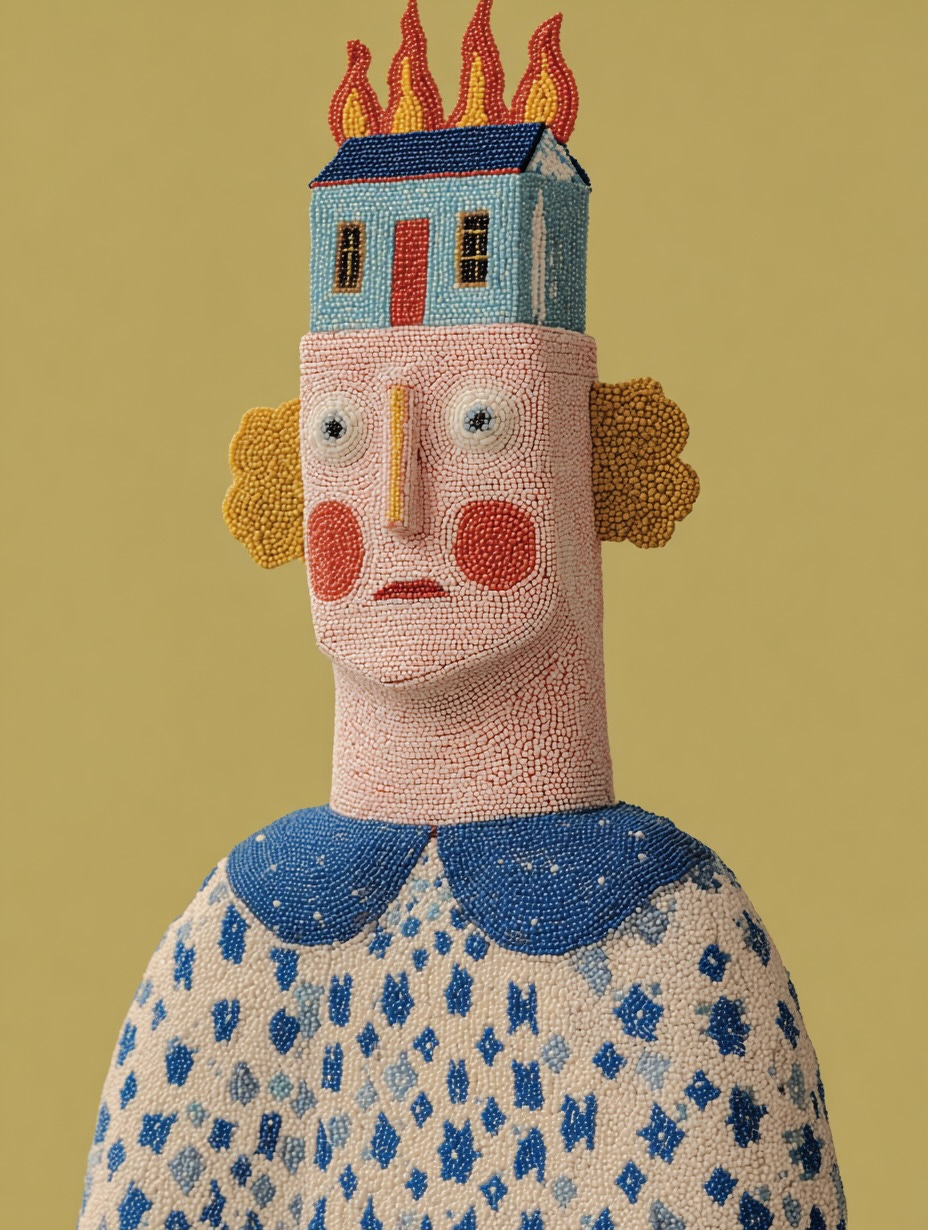


Rather than using AI as a tool of efficiency or spectacle, da Silva treats it as an oracle: a system through which latent memories, ancestral anxieties, and collective archetypes can surface. Her images behave less like illustrations and more like talismans; charged objects that stage encounters with the unconscious. Rooted in a South African sensibility yet cosmologically open, her practice suggests that AI, when approached ritually rather than instrumentally, can become a site for speculative identity, shadow work, and contemporary myth-making.
WHAT’S NEW
Not the Future Anymore: AI Becomes Pop Culture
The New York Times’ roundup frames 2025 as the year AI stopped feeling “future” and became everyday entertainment infrastructure: AI musicians climbed iTunes/Billboard, and podcast hosts used voice + translation models to “speak” languages they don’t know. Hollywood debated AI’s role in awards season (accent enhancement in The Brutalist), while deepfakes of deceased celebrities spread widely. Even legacy IP got “expanded” via AI-driven spectacle, and major studios moved from lawsuits to landmark AI partnerships. 
Residency Radar: Villa Albertine’s “Arts in the Age of AI” 2027
Villa Albertine opened applications for its 2027 “Arts in the Age of AI” residency—four selected creators/cultural professionals will do a two-month, research-and-fieldwork residency in a specific U.S. city (not an itinerant tour). The program is designed for exploration, meetings, and ecosystem immersion (universities, companies, institutions), with support organized through Villa Albertine’s network across 10 U.S. cities. Applications are due January 29, 2026 (11:59 p.m. Paris time), and a French partner organization is required. 
ChatGPT Wrapped Arrives: “Your Year with ChatGPT”
OpenAI’s “Your Year with ChatGPT” is a Spotify Wrapped-style, personalized recap rolling out Dec 22–29, 2025. Eligible users (Free/Plus/Pro, with Memory + Reference Chat History on, minimum activity threshold) get a lightweight, user-controlled experience: playful awards, “creative archetypes,” and AI-generated visuals (like pixel art) reflecting the year’s most-discussed themes—plus extras like poems. It’s opt-in, not automatic, and excluded for Team/Enterprise/Education accounts, emphasizing privacy controls similar to regular chats.
KEY VISUAL
JungSu Kim | @saysukeee
“But Then One Day!!!”
JungSu Kim works at the threshold where the ordinary quietly gives way to the impossible. In “But Then One Day!!!”, reality does not collapse; it gently dissolves. A flower opens and becomes a face. A documentary gesture slips into a vision. What begins as observation mutates into revelation. AI here is not spectacle; it is a solvent, loosening the seams between what is seen and what is felt.
The film moves with dream logic rather than narrative causality. Images do not explain themselves; they transform. Everyday life becomes porous, allowing hidden dimensions to surface; emotional residues, subconscious desires, speculative futures. JungSu’s use of AI is intimate and precise, less about automation than amplification: a way to externalize imagination without stripping it of ambiguity.
Rooted in her background across fashion, branding, character design, and entertainment, JungSu approaches generative systems as collaborators rather than tools. Efficiency is not the endpoint; freedom is. By compressing time and cost, AI creates space for experimentation, for risk, for visual thought to unfold at its own rhythm.
Presented as part of the OpenAI Creative Lab in Seoul; a month-long exhibition bringing together 21 artists; “But Then One Day!!!” feels less like a finished object than a glimpse of what comes next. A future where creativity doesn’t escape reality, but gently rewrites it from within.
That’s all for now — we’ll be back in your inbox next week.