
THE CURATED LOG XXXIV
By MITO Universe - @mito.universe

Welcome back to MITO Universe.
This week’s signals arrive as shifts in pressure rather than headlines. Exhibition halls swell into laboratories, studios redraw their internal boundaries, models learn to think at lengths once reserved for institutions. Across these movements runs a shared concern with scale: how systems expand without dissolving authorship, how intelligence accelerates without erasing judgment, how environments absorb complexity without hardening into control.
The works gathered here resonate with that tension. Bodies drift through regimes of measurement, interiors soften into climates, archives liquefy under new speeds. What emerges is a quiet continuity between infrastructure and imagination; a sense that AI, like architecture or ritual, reshapes not outcomes but conditions.
This week’s log lingers there, where form negotiates endurance.
SELECTED CREATORS
The MITO Universe grows through the people who give it form. Each week, we spotlight a creator working with AI as a deliberate, authored practice. If you’re shaping worlds, systems, or a distinct visual language, this is where it belongs. Become part of the community and start building your own MITO Universe account.
MITO UNIVERSE CREATIVE SPOTLIGHT: Yar Kirsanov | @yarkirsanov
Yar Kirsanov’s images unfold as humid chambers of transition, spaces where the body drifts between states rather than occupies a stable form. Wings, flowers, faces, measurement scales, archival fragments; each element behaves less like a symbol than a current, pulling the anthropomorphic figure into a field of perpetual circulation. The body appears repeatedly, yet never settles. It emerges as a scaffold through which textures pass: photographic grain, digital blur, spectral light, algorithmic incision.
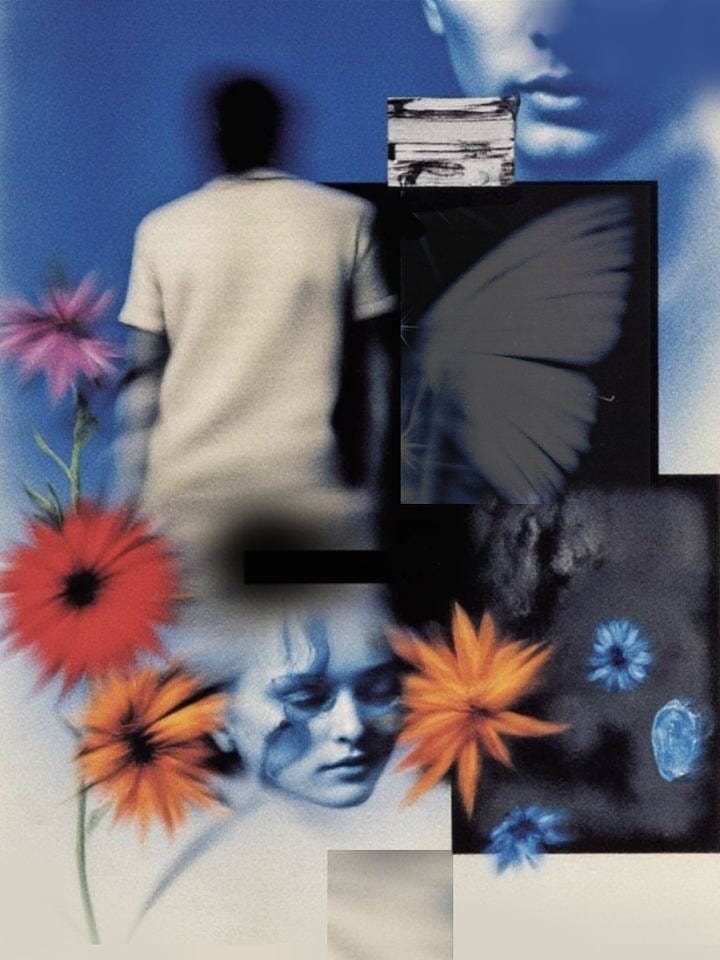
This practice recalls the legacy of collage not as rupture but as ecology. Where early Dada cut to expose the violence of representation, Kirsanov assembles to sustain a fragile continuity. The figure persists by adapting, borrowing organs, grafting interfaces, allowing itself to be measured, scanned, multiplied. Identity here resembles a tide chart; periodic, provisional, sensitive to external forces. One senses echoes of Haraway’s cyborg, yet stripped of manifesto, rendered intimate and vulnerable.


Butterflies recur as carriers of tempo rather than transcendence. They register metamorphosis as process, not arrival. Light pierces bodies like architectural apertures, suggesting inner rooms without walls. The works hover between devotion and diagnostics, between icon and interface.
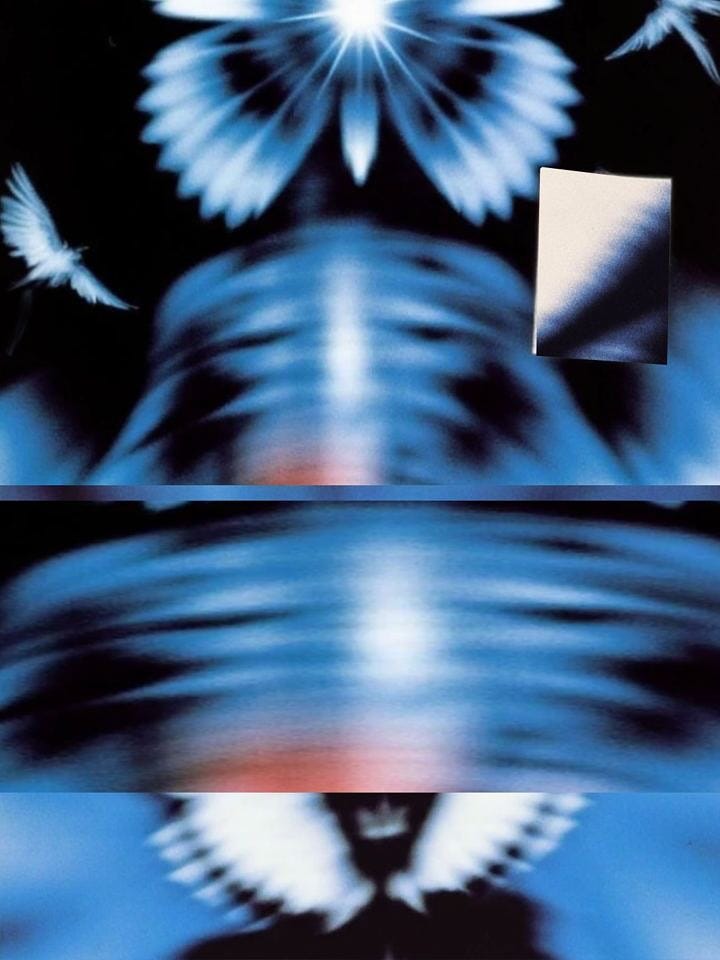


Artificial intelligence operates less as author than as climate. It thickens the air in which these figures breathe, accelerating recombination while dissolving origin. Kirsanov’s images ask how a body might endure under such conditions; how it learns to float, to fragment, to glow briefly, and to remain legible while continuously becoming other.
Alba de la Fuente | @albadlfuente_
Alba de la Fuente’s work unfolds at the threshold where architecture loosens its grip on function and begins to behave like a medium of thought. These interiors do not announce themselves as spaces to be occupied so much as conditions to be entered; volumes tuned to modulate attention, tempo, and bodily orientation. Light arrives as a continuous surface, stretched across ceilings like a calm sky trapped indoors, recalling both the luminous rationalism of late modernism and the anesthetic glow of contemporary interfaces.
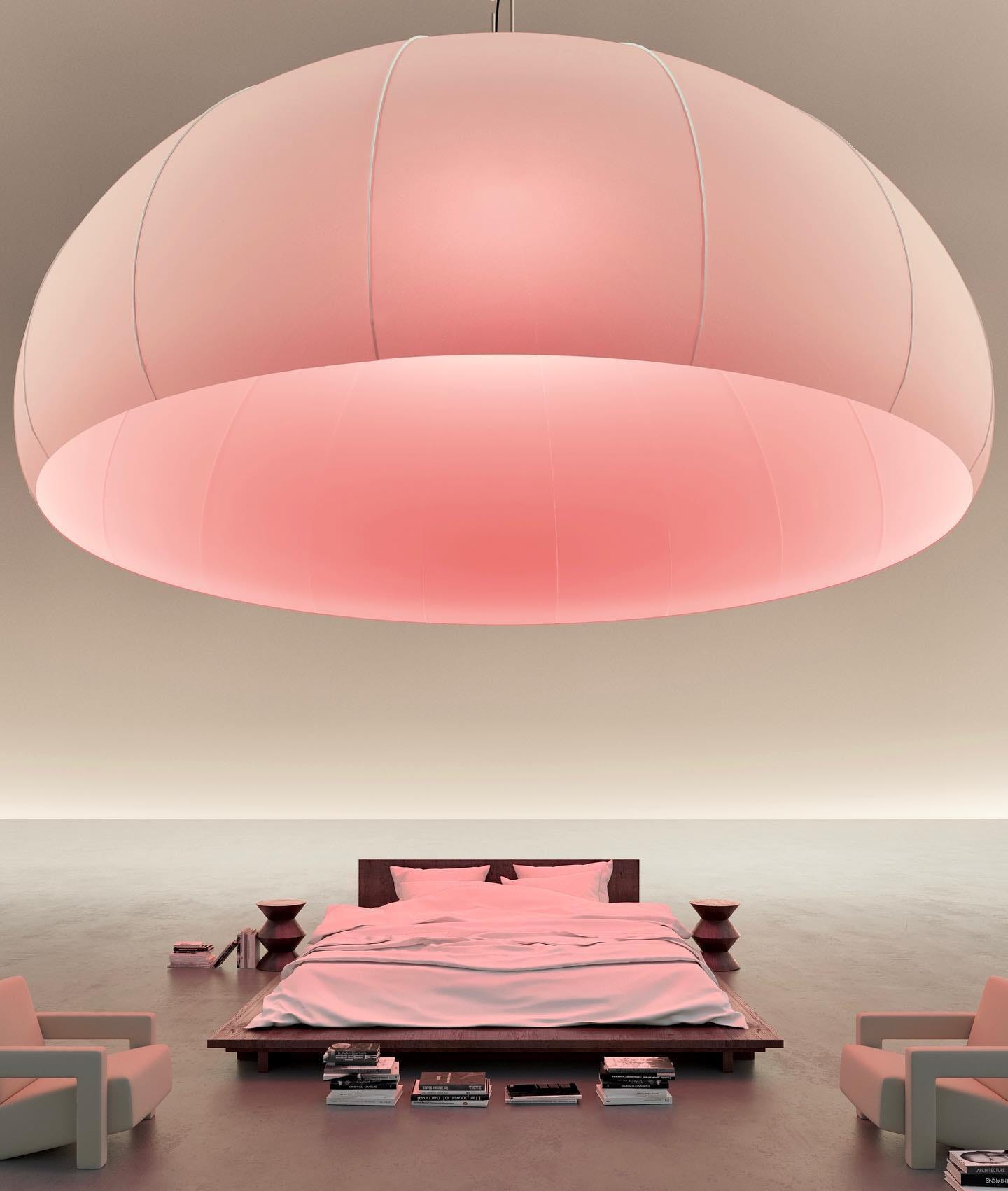
Her curved bars, sunken rooms, and inflated ceilings draw the eye into slow circuits. Movement here is not linear; it eddies. One thinks of Gaston Bachelard’s poetics of interiority, where space acquires psychological depth, or of Peter Sloterdijk’s spheres; environments designed to hold life in suspension. Alba’s spaces shelter without enclosing, suggesting a politics of softness that resists the hard edges of surveillance architecture and productivity-driven design.
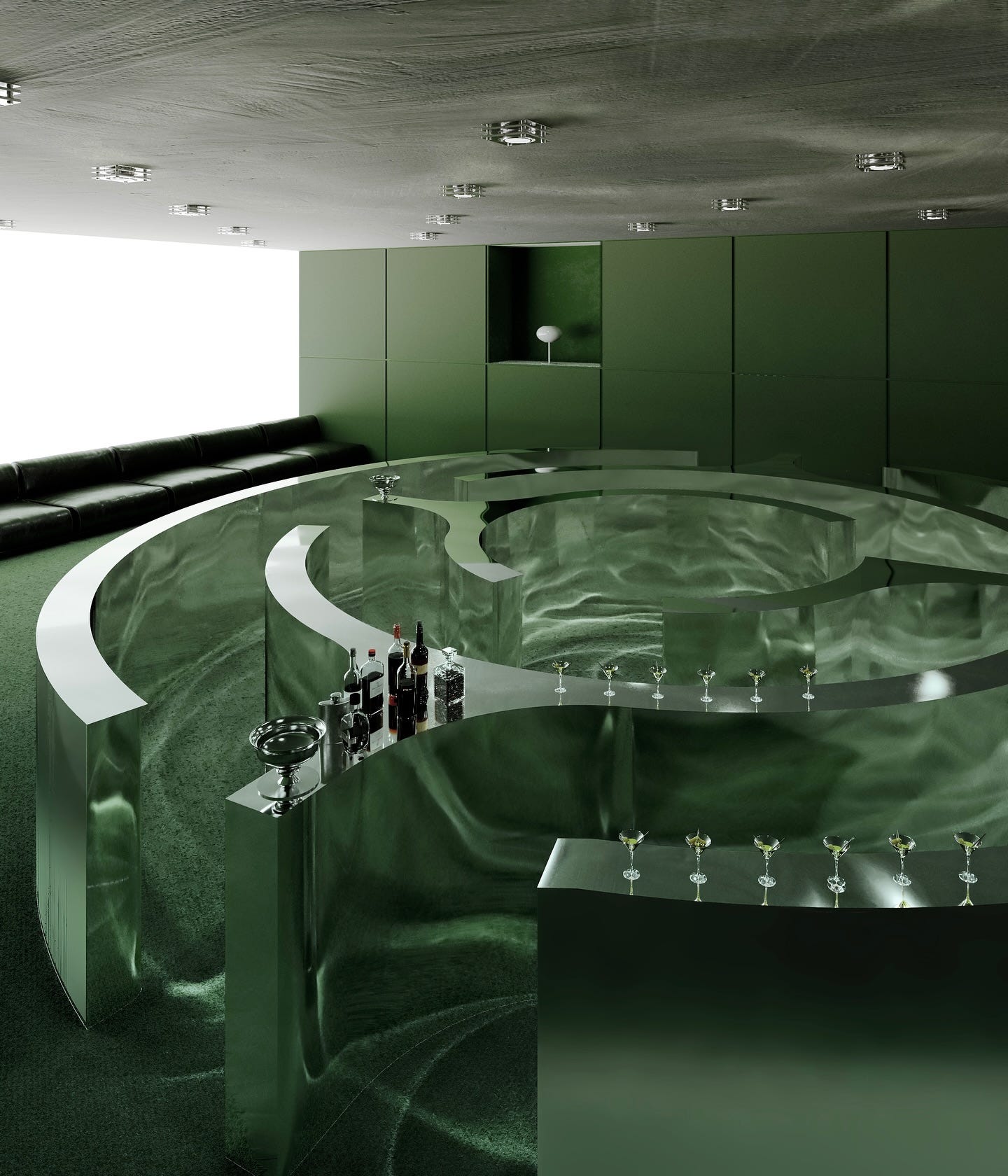


Materiality remains central, even when generated through AI. Surfaces ripple like water under glass, fabrics appear padded with air, metallic planes absorb light instead of reflecting authority. AI operates as a calibrating force, maintaining equilibrium between control and drift, precision and atmospherics. The resulting images hover between lounge, sanctuary, and infrastructural diagram.


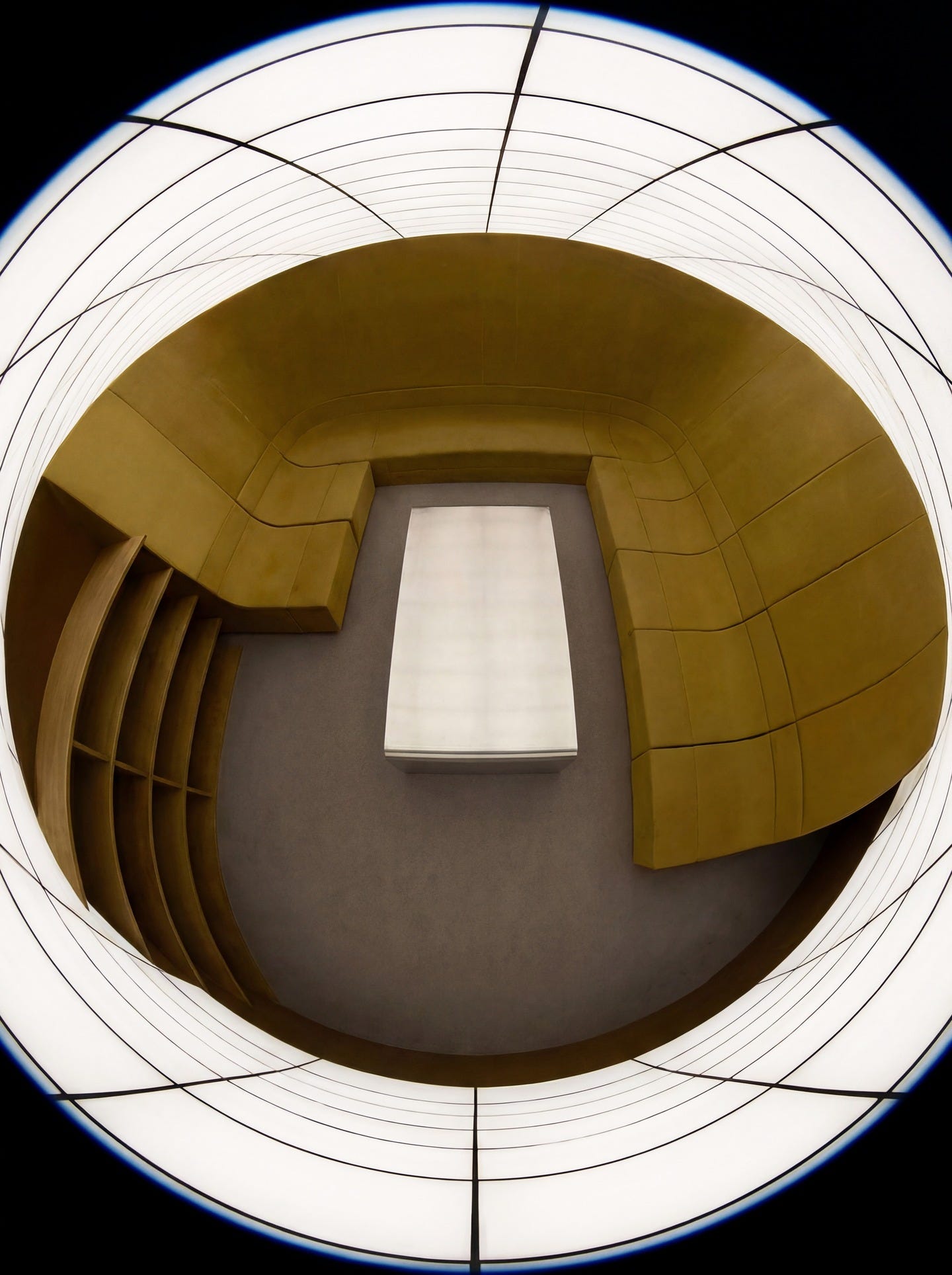
What emerges is an architecture of duration rather than monumentality. These rooms seem built for waiting, for conversation without urgency, for bodies that linger. Alba opens a question that remains unresolved: how might digital tools help reimagine space as a shared climate; ethical, sensorial, and temporal; rather than a container for optimized behavior?
Check out Alba’s latest video “HUMAN INTERFACE“ created with MITO AI
WHAT’S NEW
Barcelona Becomes the Global AV Lab for AI
The Integrated Systems Europe (ISE) congress kicks off in Barcelona as the world’s most influential audiovisual industry fair, with a sharp focus on artificial intelligence and cybersecurity. Spanning over 100,000 square meters and hosting 1,700 exhibitors, ISE translates emerging tech trends into real, high-complexity audiovisual devices used across media, events, and smart environments. New highlights include a dedicated CyberSecurity Summit and “Spark,” a new track for creative industries. With record attendance expected, ISE reinforces Barcelona’s growing role as a global hub for AI-driven audiovisual innovation.
Amazon MGM Embraces AI; But Draws a Line Around Creativity
Amazon MGM Studios is integrating AI into film and TV production to reduce costs and streamline workflows, while insisting that creative decision-making remains human-led. Through a new internal AI Studio, Amazon is testing tools designed to accelerate production without replacing writers, directors, or designers. Led by Albert Cheng, the initiative responds to soaring production costs that limit creative risk-taking. With industry partners already onboard and a beta launching soon, Amazon positions AI as an assistive layer—optimizing scale and efficiency while keeping storytelling firmly in human hands.
Claude Opus 4.6 Raises the Bar for Long-Form Thinking and Creative Workflows
Anthropic has released Claude Opus 4.6, a major upgrade to its most advanced model, introducing a 1-million-token context window and stronger agentic reasoning. Designed for sustained, complex tasks, Opus 4.6 excels in large codebases, long-form research, and multi-step creative and knowledge work. New features like adaptive thinking, effort controls, and agent teams make it especially powerful for creators, developers, and studios managing large projects. Crucially, Anthropic pairs these gains with extensive safety testing, positioning Opus 4.6 as both more capable and more reliable for professional creative use.
KEY VISUAL
Maks | @m8kss
In YEEZ.reimaginated, Maks approaches the archive as a volatile substance rather than a stable inheritance. The video’s frames move across sites that oscillate between experiment, ritual, and spectacle: the monitored runner suspended on a treadmill, the monastic group consuming apples in synchrony, the herd surging toward the lens, the automotive body revealed beneath a draped skin. Each scene behaves like a pressure chamber in which twentieth-century myths of discipline, speed, faith, and power are tested against contemporary regimes of visibility.
The running body is central. Wired, measured, exposed, it recalls both Cold War biomechanics and the neoliberal fantasy of endless optimization. Yet the surrounding apparatus feels strangely archaic; metallic, analog, almost devotional. Measurement becomes choreography. Control leaks into ceremony. Here one hears echoes of Foucault’s disciplined body, though filtered through the aesthetic logic of advertising, where critique and seduction share the same surface.
Maks structures the video through a play of environments: desert, cloister, laboratory, showroom. These are spaces of extraction and belief, zones where bodies are prepared for circulation. Motion functions like water moving through connected basins; energy transfers, accumulates, dissipates. Even the car, partially veiled, reads as an animal form awaiting animation, its velocity deferred.
AI operates as an editor of temporal strata, compressing historical gestures into a continuous present. The result resists nostalgia. Instead, it stages a suspended future, one in which branding, ritual, and biomechanics remain entangled. YEEZ.reimaginated leaves open a quiet question: when speed becomes doctrine, what forms of stillness (or refusal) remain imaginable within the image?
That’s all for now — we’ll be back in your inbox next week.
Excellent new entry. Have a creative and productive day!