
THE CURATED LOG XXXVI
By MITO Universe - @mito.universe

Welcome back to MITO Universe.
This week, the landscape of AI creation feels tectonic.
This week, the question of authorship sharpens into something almost tactile. AI doesn’t disappear into the background, it becomes the site where intention is tested. Where does the machine end and the stylist begin? Where does the art director’s eye stop and the algorithm’s suggestion start? The creators we spotlight this week don’t resolve that tension. They inhabit it, deliberately, and make it productive.
In fashion, surrealism stops being a mood board reference and becomes structural logic, rural symbols elevated into fable, objects reframed as totems. In visual design, luxury is dissected under laboratory conditions: cold, precise, and quietly addictive. In video, the uncanny takes the wheel entirely, lo-fi dread and absurdist montage as a new form of cinematic authorship.
The question persists across all three: when the tool is this powerful, what does it mean to direct it?
SELECTED CREATORS
The MITO Universe grows through the people who give it form. Each week, we spotlight a creator working with AI as a deliberate, authored practice. If you’re shaping worlds, systems, or a distinct visual language, this is where it belongs. Become part of the community and start building your own MITO Universe account.
MITO UNIVERSE CREATIVE SPOTLIGHT: Alexia Sidibe | @alexiasidibe
Alexia Sidibé works in the register of the intimate and the botanical, a space where romance is not a grand gesture but a breeze, where emotion lives in skin, in light filtered through leaves, in a figure caught mid-turn inside a garden labyrinth. The Paris-based art director brings a background in advertising, branding, and audiovisual production to images that feel, above all, like the beginning of a story that hasn’t announced itself yet.


Movement is her primary narrative tool — not action, but choreography. Hair lifted by wind, a body mid-rotation, a soft blur across a face before the camera settles. These are not fashion poses; they are states. The figure is always in something — thought, motion, a private moment that the image catches without disturbing. Selective focus and occlusion do the rest: branches, hair, diffused foregrounds that ask you to look through rather than at. Intimacy is constructed through obstruction.
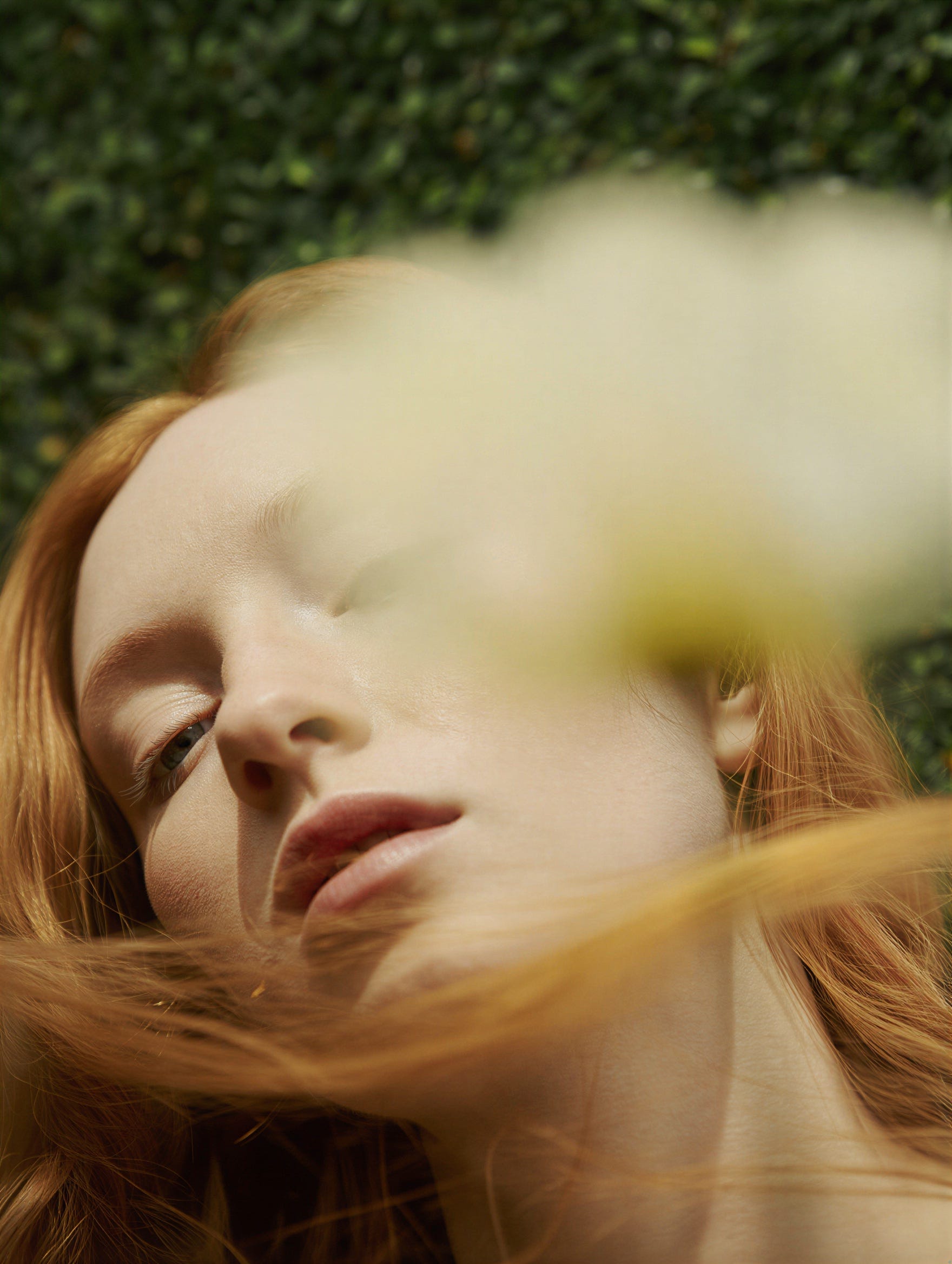
The skin is real, tactile, lit with the softness of late afternoon sun through foliage. There’s no hyper production visible, what the images produce is closeness, not polish. Scale alternates between the wide (the labyrinth as world) and the close (the face as emotion), building a visual rhythm that feels cinematic without borrowing from cinema’s grammar.
The palette carries it all quietly: deep greens against milk and mint, copper hair as a recurring brand accent, golden-hour warmth with contained contrast. Organic, but curated to the point of becoming architectural. The garden is not wild, it is ordered, almost ritualistic. Nature domesticated into elegance.
Botanical romanticism with editorial precision: soft light, real skin, and coreographed movement telling an intimate escape inside a garden that was always also a frame.
All of this project was fully conceived, art-directed and produced inside MITO.
María Vinagre | @maria.vinagre.humain
Maria Vinagre doesn’t use AI to simplify fashion she uses it to mythologize it. The Portuguese stylist and creative director, now based in Paris, brings fifteen years of editorial instinct to a practice that sits at the precise intersection of surrealism, sustainability, and visual storytelling. Her collaborations with houses like Dior and her landmark work producing Vogue’s first AI-generated cover position her not as a technologist but as a narrator, one who happens to have found a new language.
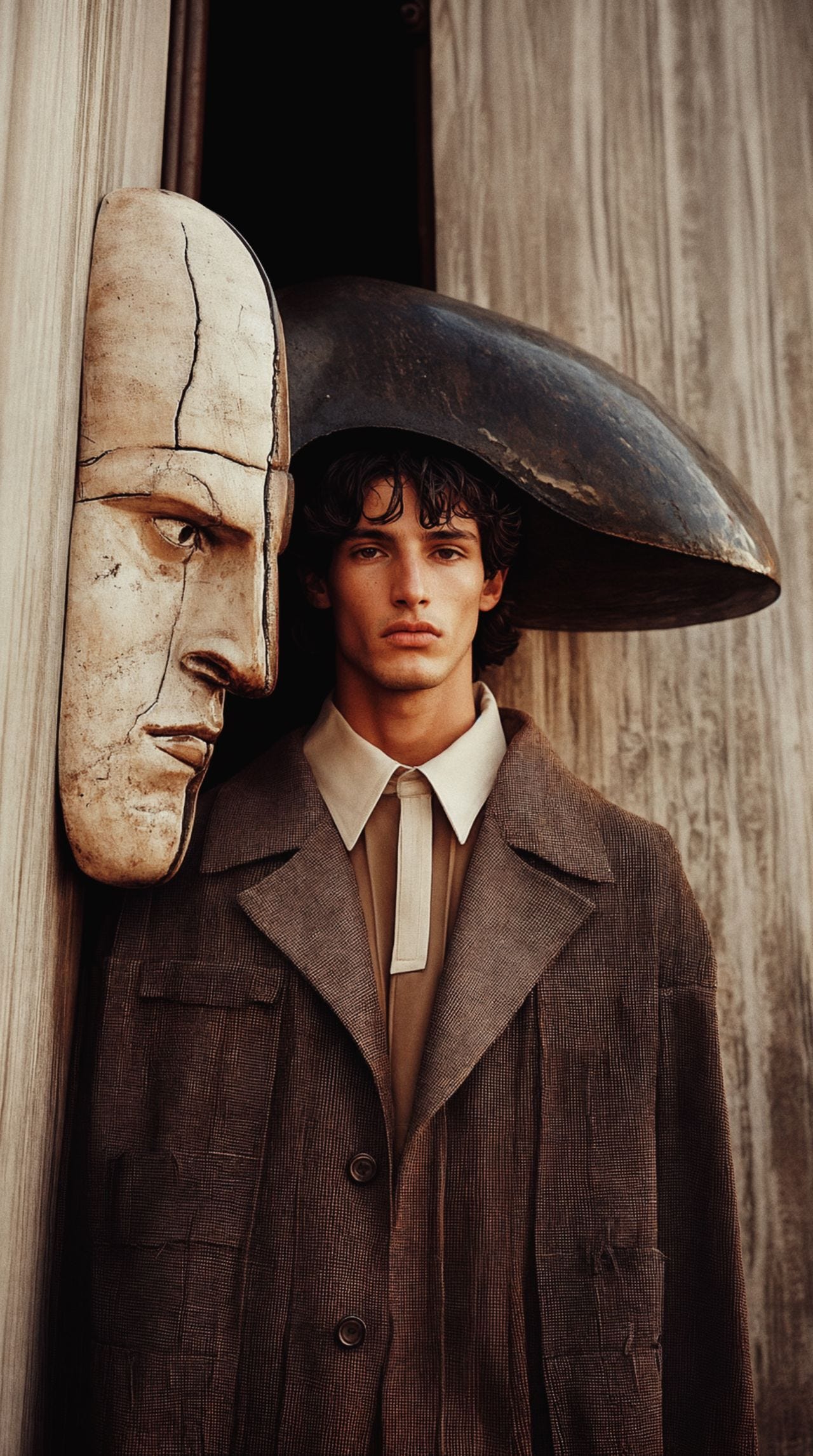
What the images reveal is a sustained commitment to what might be called rural fable logic: a world where a red leather armchair belongs in a barn, where a turkey with a bow becomes a co-protagonist, where a cabbage field is as valid a backdrop as any studio cyclorama. The casting carries it hieratic presences, frontal gazes, expressions that offer nothing but demand everything. Emotion lives in the silence between pose and prop, not in the face.
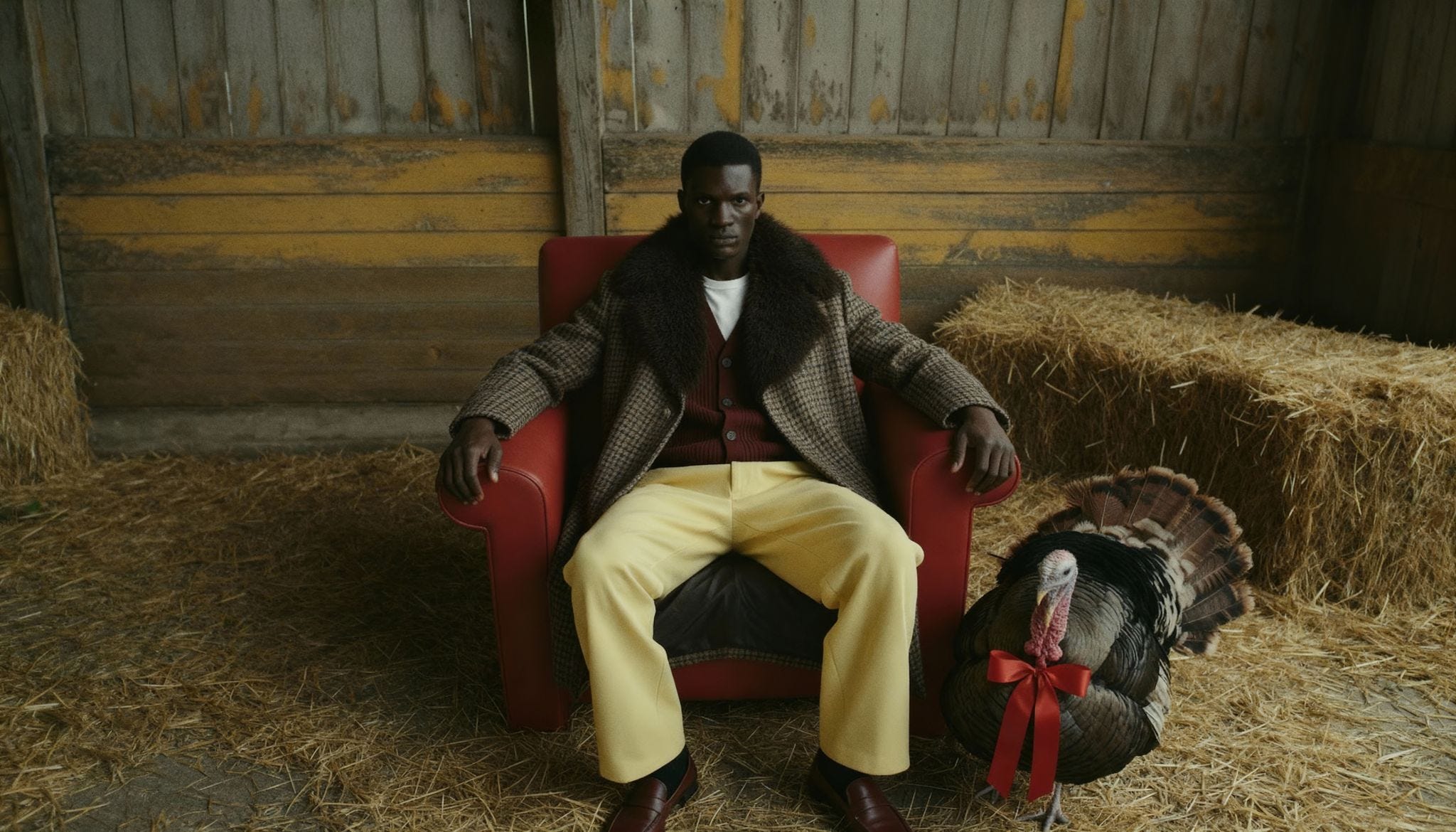
The palette refuses warmth as comfort. Ochres, burgundies, butter yellows, and overcast greens, an autumnal register that feels European in its restraint, cinematic in its gravity. Light arrives diffused, almost winter-flat, giving the images a filmic grain that preserves the organic even within the produced. The props, animals, vegetables, masks, aged furniture, are never decorative. They’re totemic. They build myth one object at a time.

This is camp fashion with a dry sense of humor, surrealisme éditorial in the tradition of the found object reinterpreted, and European slow cinema folded into a single frame. High fashion in the key of rural fable: a sober surrealism, autumnal in palette and hieratic in gesture, where the everyday becomes symbol and humor enters wearing gloves.
WHAT’S NEW
AI Video’s leap: From Clip Generator to Synthetic Cinema Engine
Something is shifting in AI video and it’s not just resolution. The models emerging this week suggest the technology has crossed a threshold: from tools that generate isolated clips to systems that understand continuity, narrative, and multimodal context all at once. Text, image, video, and audio processed together. Longer sequences. Fewer artifacts. And crucially creative control over camera behavior and character consistency.
Two models define this moment. Seedance 2.0, already making its way to MITO, pushes multimodal generation into genuinely editorial territory: it reads image, video, and audio references simultaneously, replicates specific camera movements and complex choreographies, maintains character identity across a sequence, and allows creators to extend, merge, or correct specific segments without regenerating the whole. Audio-video sync arrives at a new level of precision, sound is no longer applied after the fact but woven into the generative logic from the start.
Kling 3.0 is also coming soon on MITO and represents a different but complementary leap. Character consistency, gesture reading, stable lighting across duration: these aren’t refinements, they’re the beginning of a new category. The director’s role shifts accordingly, from requesting a finished video to exploring, iterating, and perturbing a simulated universe.
What both models point toward is the same destination. The battle is no longer about who has the most spectacular model, it’s about who defines the standard of visual language and creative control over this new raw material. Between Kling, Seedance 2.0, and their successors, a future is taking shape built on persistent “scenario-models”: living spaces where identity, sound, and movement are variables to be orchestrated, not assets to be assembled.
The pipeline isn’t being streamlined. It’s being replaced.
KEY VISUAL | @m8kss
What Maks constructs in this video is less a narrative than a taxonomy of wrongness a montage in which familiar spaces (basements, corridors, chapels, fields) are quietly evacuated of their logic and restocked with images that almost make sense. A clock reading 11:85. A microwave detonating in fog. Nuns smoking with the calm of people who have seen everything. An elevator that opens onto open ocean.
This is dreamcore as editorial discipline: Weirdcore aesthetics pressed into a formal rigor that prevents the work from collapsing into mere provocation. The lo-fi grain, the desaturated palette, the 90s and early 2000s object vocabulary these aren’t nostalgia gestures. They’re disorientation tools. The past is mobilized not for feeling but for uncanniness, for that specific sensation of a memory that doesn’t belong to you.
The text at the close “human direction. -by Maks” arrives as both signature and argument. In a moment when AI generation proliferates across video, the insistence on human direction is a position, not a credit. It asks the viewer to locate the author inside the machine output, to find the decisions that couldn’t have been automated: the particular absurdism, the specific rhythm of the montage, the choice of the hooded figure running endlessly away.
Isolation, latent threat, and a dark humor that surfaces only in dissonance. This is cinema made from wrongness, authored from within the algorithm.
All of this project was fully conceived, art-directed, produced, and edited inside MITO.
That’s all for now — we’ll be back in your inbox next week.