
THE CURATED LOG XXXVIII
By MITO Universe - @mito.universe

Welcome back to MITO Universe
This week, consolidation became clarity.
The question reshaping AI video this April isn’t “which model wins?” but “which models survive?” Disney walked away from OpenAI’s planned $1B partnership as Sora counts down to April 26 shutdown. The exit clarifies what sustains and what doesn’t: unit economics matter more than hype, distribution beats features, and the gap between technological possibility and commercial viability remains wider than the industry wanted to admit.
What filled Sora’s absence wasn’t chaos but reordering. The market sorted itself into legible tiers — Grok for consumers and meme-makers, Runway holding the professional middle, Kling and Veo competing for different production segments. Meanwhile iQIYI announced April 20 that most of its content will be AI-generated by 2031, unveiled Nadou Pro as end-to-end filmmaking toolkit, and launched controversial AI Actor Database connecting filmmakers with digital likenesses. Not speculative futures. Operational present in China’s streaming ecosystem.
The same week saw disinformation accelerate into “slopaganda” — low-quality, high-volume AI videos flooding social media during US-Iran tensions. Fake Trump hospitalizations, fabricated military strikes, Iranian embassy meme warfare, all carrying Google SynthID watermarks proving origin. When generation becomes this accessible, truth and fiction don’t just blur — they multiply faster than verification systems can process.
Below, artists working with AI as authored practice, and one Universe creator whose retrofuturism treats 2055 as archival present.
SELECTED CREATORS
The MITO Universe grows through the people who give it form. Each week, we spotlight a creator working with AI as a deliberate, authored practice. If you’re shaping worlds, systems, or a distinct visual language, this is where it belongs. Become part of the community and start building your own MITO Universe account.
MITO UNIVERSE CREATIVE SPOTLIGHT:
Felipe Valério (Wait) | @wait_2055
São Paulo-based creative and MITO Universe featured artist operating under the alias "Wait" — the account name @wait_2055 signals temporal displacement proposition. Work explores retrofuturism and speculative documentation, constructing images that purport to arrive from 2055, presenting near-future scenarios through aesthetic vocabulary that feels simultaneously archival and synthetic.


Valério treats AI as time machine for visualizing futures that feel photographically documented despite never having existed, engaging questions about evidence, documentation, and how synthetic images acquire documentary authority through formal choices that mimic photographic veracity. The practice demonstrates how generative tools enable not just spatial but temporal narrative construction, creating artifacts from futures that exist only as computational possibility.
By dating the work 2055 and maintaining consistent near-future aesthetic across outputs, Valério builds coherent speculative timeline where viewers encounter what appears to be documentation from decades ahead. The work positions AI generation as science fiction methodology, treating the gap between present and generated image not as technical limitation but as conceptual space where futures get visualized before they arrive.
Ksenia | @ksyush.ai
London-based content creator constructing surrealist self-portraiture where the photographed body becomes raw material for algorithmic transformation. Work begins with real shoots — Ksenia herself as subject — then extends captured moments through AI into impossible scenarios that maintain physical presence while dissolving spatial logic.
Fashion editorial aesthetics meet digital surrealism: figure in leopard coat on African savanna, fabric pattern liquefying into autonomous visual system, floral adornments replacing anatomical features. The practice treats self-portraiture not as documentation but as departure point for identity exploration through generative manipulation, where "blending real shoots with AI" means using one's own image as canvas for algorithmic intervention.
Each image investigates how the self remains recognizable even as environment, texture, and physical laws transform around it. The work asks: when you can generate any backdrop, any scenario, any impossible fusion of figure and pattern, what aspects of identity persist? The answer Georgiev provides through consistent return to her own face, her own body: selfhood as anchor point that remains constant while everything else liquefies into algorithmic possibility.
WHAT’S NEW
Avalon GloboCare Announces AWS Partnership for Agentic Video Platform
Avalon Quantum AI secures $125K AWS funding for Phase 2 Catch-Up development. Caylent appointed to transform manually-configured tool into autonomous system enabling non-technical creators to generate personalized multi-platform video. Four-month completion timeline targets SaaS model scaling and broader market adoption.
Workflow Acceleration Surpasses Production Capability as Bottleneck
Marketing teams generating 10-20 complete video variations in single afternoon, A/B testing within 48 hours, scaling winners same week. Stanford AI Index reports adoption rates exceeding personal computer and internet historical curves. Teams not integrating AI video generation by mid-2026 operating at structural competitive disadvantage.
Gemini 3.1 Flash-Lite Launches at $0.25 Per Million Tokens
Google releases efficiency-focused model delivering 2.5x faster response times, 45% faster output generation versus earlier Gemini versions. Pricing reflects industry shift toward affordability benefiting startups and enterprises, intensifying cost-efficiency competition among frontier providers.
KEY VISUAL
Orora Studio @orora.studio.ai
Orora Studio constructs botanical portraiture where flowers function not as subject but as prosthetic enhancement integrated directly with human figure. The work positions organic material — petals, blooms, stems — as wearable elements that blur boundary between adornment and anatomy, then processes this hybrid form through AI to achieve states that exist between natural growth and synthetic augmentation. Young women appear in outdoor settings carrying impossible floral modifications: petals replacing eyelashes, white blooms functioning as elaborate headpieces, delicate flowers emerging from skin as if naturally occurring rather than applied.
The images occupy uncertain categorical territory. They reference fashion photography’s history of botanical styling while pushing past decorative function into something more integral. Reference nature photography’s tradition of close botanical study while reversing the premise: instead of isolating flower from context, the flower becomes context for human presence. Reference digital beauty filters’ logic of facial augmentation while materializing that augmentation as physical organic matter rather than purely synthetic overlay. What emerges feels simultaneously like editorial fashion, speculative biology, and proposition about futures where cosmetic possibility extends beyond makeup and modification into generative hybridization.


The staging operates through careful ambiguity about what was captured versus what was generated. Figures photographed in natural light beside rivers, among trees, against sky suggest documentary basis. The floral elements appear physical enough to cast shadows, catch light, possess textural specificity. Yet their integration with body — eyelashes that transition seamlessly into petal formations, blooms that seem to grow from scalp rather than rest upon it — signals algorithmic intervention. The work doesn’t announce its seams. It maintains productive uncertainty about where photography ended and generation began, treating that ambiguity not as technical limitation but as conceptual foundation.
What distinguishes the practice from straightforward AI portraiture is insistence on botanical material as mediating element. This isn’t figure generation where flowers happen to appear as decorative detail. The flowers carry conceptual weight, functioning as primary site where human and algorithmic meet. They suggest organic computation, natural forms processed through digital systems that understand pattern, symmetry, growth logic well enough to convincingly integrate synthetic bloom with photographed body. The palette reinforces this: images favor whites, pale pinks, soft natural tones that emphasize delicacy while maintaining enough contrast to read structural detail in petal arrangement.
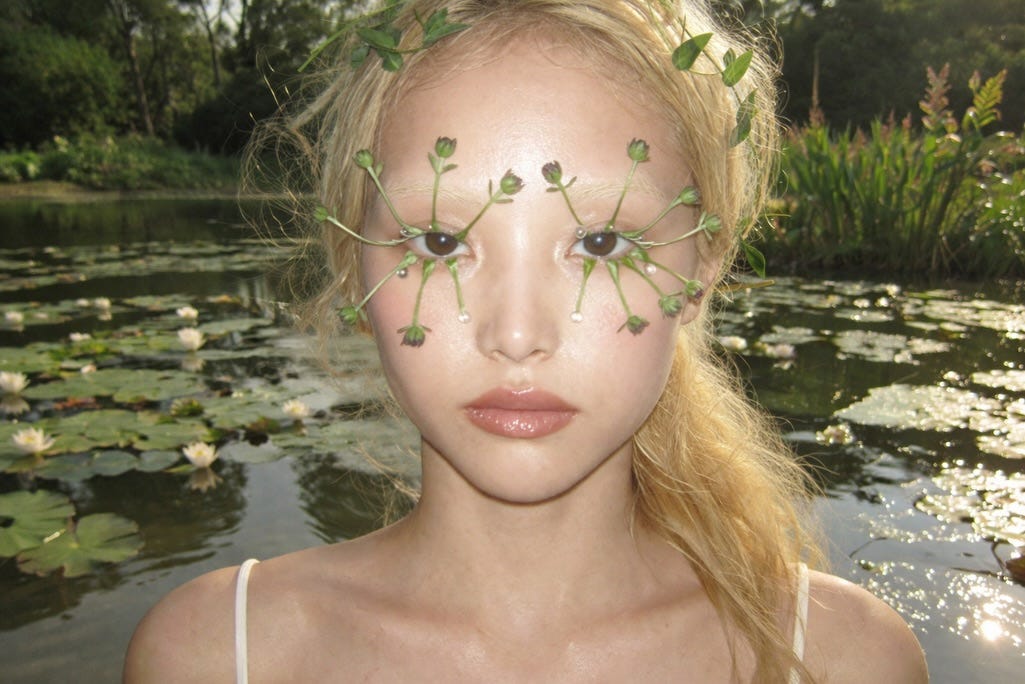
The work proposes futures where enhancement operates through nature-technology hybrid rather than purely synthetic means. Where the question isn’t human versus machine but how biological and algorithmic systems might integrate at level of appearance, where flowers function less as decoration and more as interface between body and generative capability. The young women photographed become demonstration of this possibility, their naturalness — river settings, soft light, casual poses — serving as ground against which floral augmentation registers as proposition rather than fantasy. The work asks: if AI can make petals appear to grow from skin convincingly enough to produce visual uncertainty, what becomes possible when we stop treating natural and synthetic as opposed categories and start treating them as compatible material vocabularies for constructing appearance.
That’s all for now — we’ll be back in your inbox next week.