
THE CURATED LOG XXXII
By MITO Universe - @mito.universe

Welcome back to MITO Universe.
This week unfolds across multiple thresholds. Machines learn to reconstruct space and time from moving images. Synthetic video reaches a point where perception can no longer keep up. In Florence, algorithms organize color into an exhibition. Together, these signals describe a shifting visual order: presence without capture, motion without origin, materiality without touch.
Inside that landscape, the featured practices turn inward. Objects become speculative. Figures hover between portrait and projection. Surfaces hold memory. Across still life, fashion, and architectural minimalism, a shared question emerges: What happens to image-making when reality becomes optional?
SELECTED CREATORS
The MITO Universe grows through the people who give it form. Each week, we spotlight a creator working with AI as a deliberate, authored practice. If you’re shaping worlds, systems, or a distinct visual language, this is where it belongs. Become part of the community and start building your own MITO Universe account.
MITO UNIVERSE CREATIVE SPOTLIGHT: Laura López | @laloto
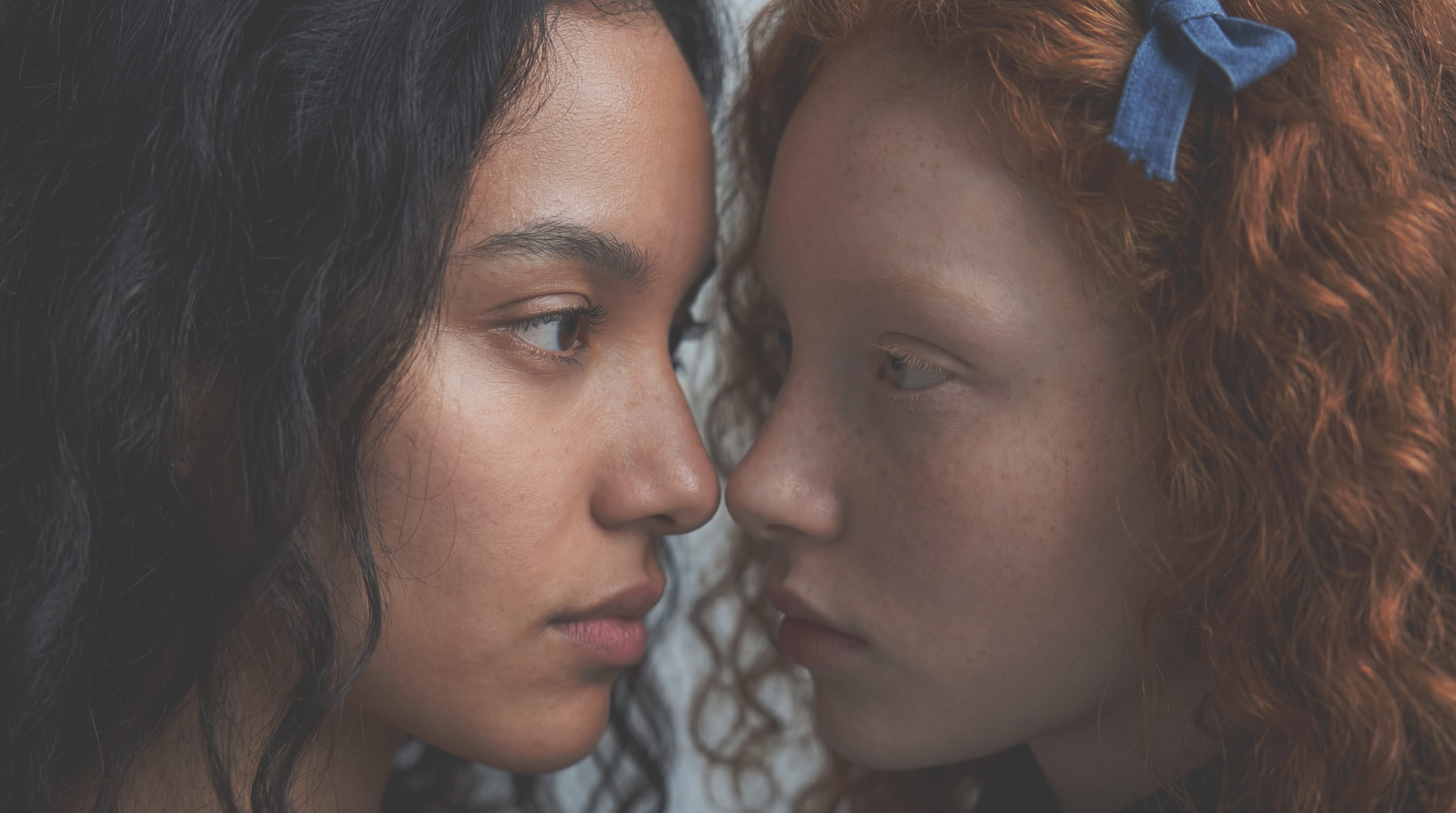
Looking at Laura López's MITO Universe portfolio, we encounter a body of work that operates at a fascinating threshold between classical aesthetic concerns and the emerging grammar of AI-generated imagery. Where last week we examined her fashion film for Gimaguas as a meditation on collapsed production time, these new images present something more architecturally complex: a sustained investigation into how machine vision constructs what we might call the "interior life" of objects and spaces.



Her metallic vessels evoke modernism and heritage craft, yet exist only as synthesized forms; objects with weight and detail, untouched by manufacture. The figures she generates carry a softened, dreamlike quality, posed in profiles and inward gestures that echo traditional portraiture while acknowledging their synthetic origin. These images suggest a kind of posthuman naturalism, where presence is implied rather than embodied.
Laura stages everything within restrained, minimalist environments; curtains, bare rooms, muted architectural backdrops; that recall Constructivist spatial experiments. Here, however, the spaces feel like future ruins: clean, detached, shaped by aggregated visual culture. What sets Laura apart is her commitment to restraint. She avoids spectacle, allowing small inconsistencies; light behaving strangely, textures slipping at the edges; to surface as part of the work’s texture. Her practice treats AI as a material with seams.
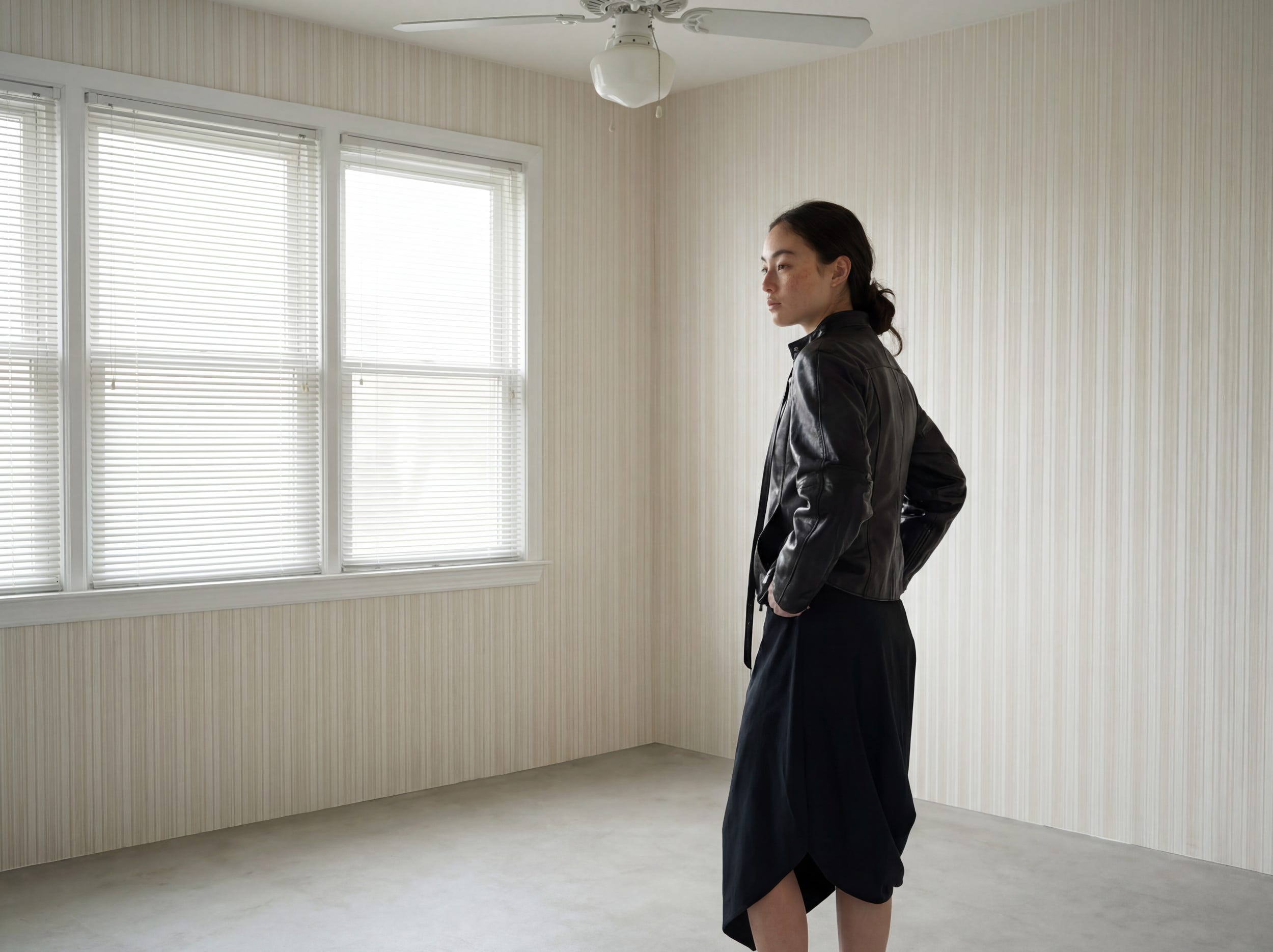
The result feels less like demonstration than inquiry: still life, portraiture, and interiors made unfamiliar again, revealing how image-making shifts when synthesis replaces capture.
Riccardo Romani | @rromz.ai
Riccardo’s AI work dismantles the very categories his photographic practice claims to synthesize. Where his street-fashion photography promises “meaningful details” as “gateways to the soul,” these images reveal detail as pure surface; a decorative imperative severed from indexical truth.
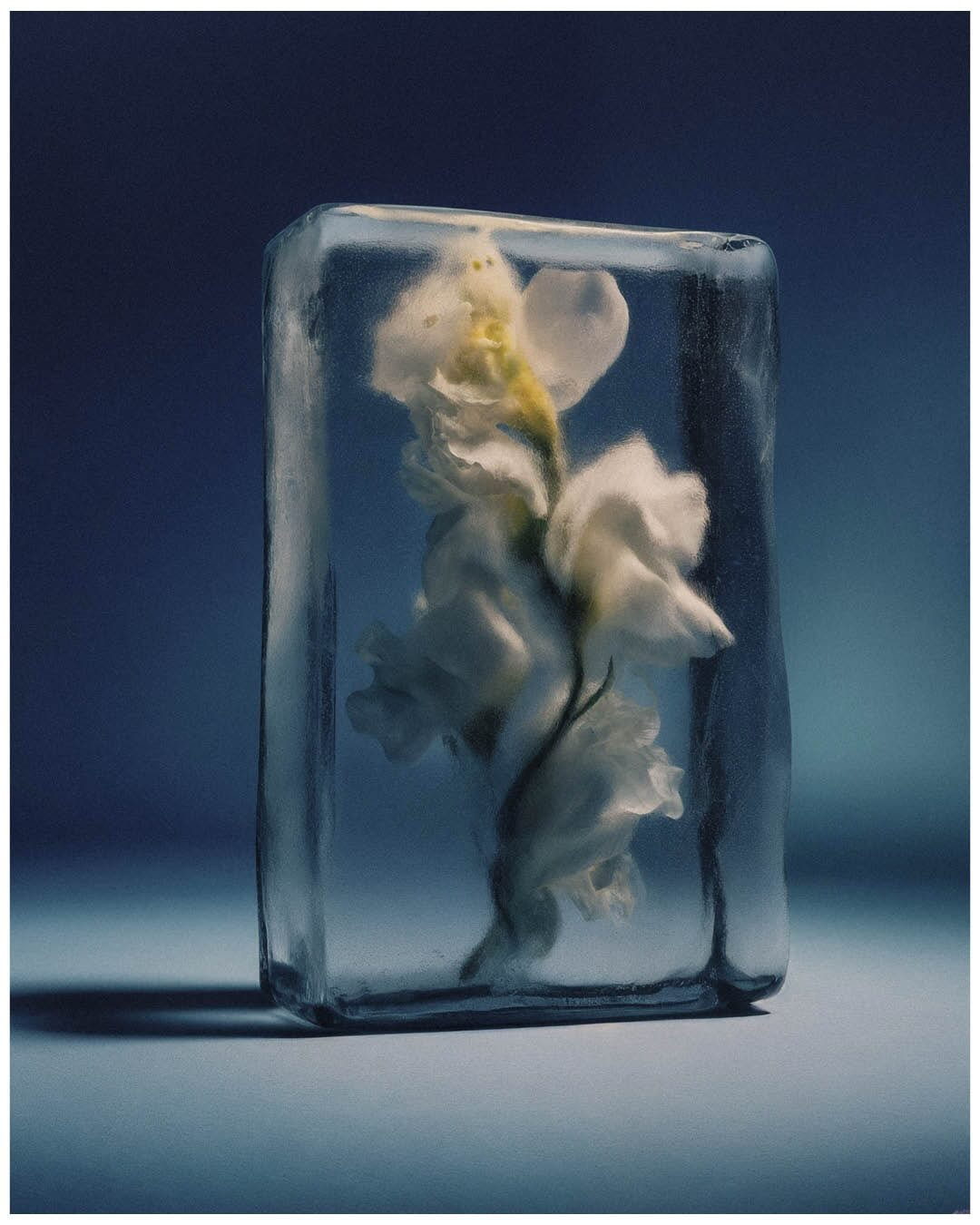
The ballet tutus transformed into architectural forms, the floral-helmeted skier, the frozen orchid; each constitutes what we might call detached ornament: excessive decoration liberated from its host body. These aren’t portraits but studies in formal displacement, where the subject dissolves into its costume, into pure aesthetic possibility. The figures wearing voluminous fabric flowers become less human than sculptural armatures for textile experiments.
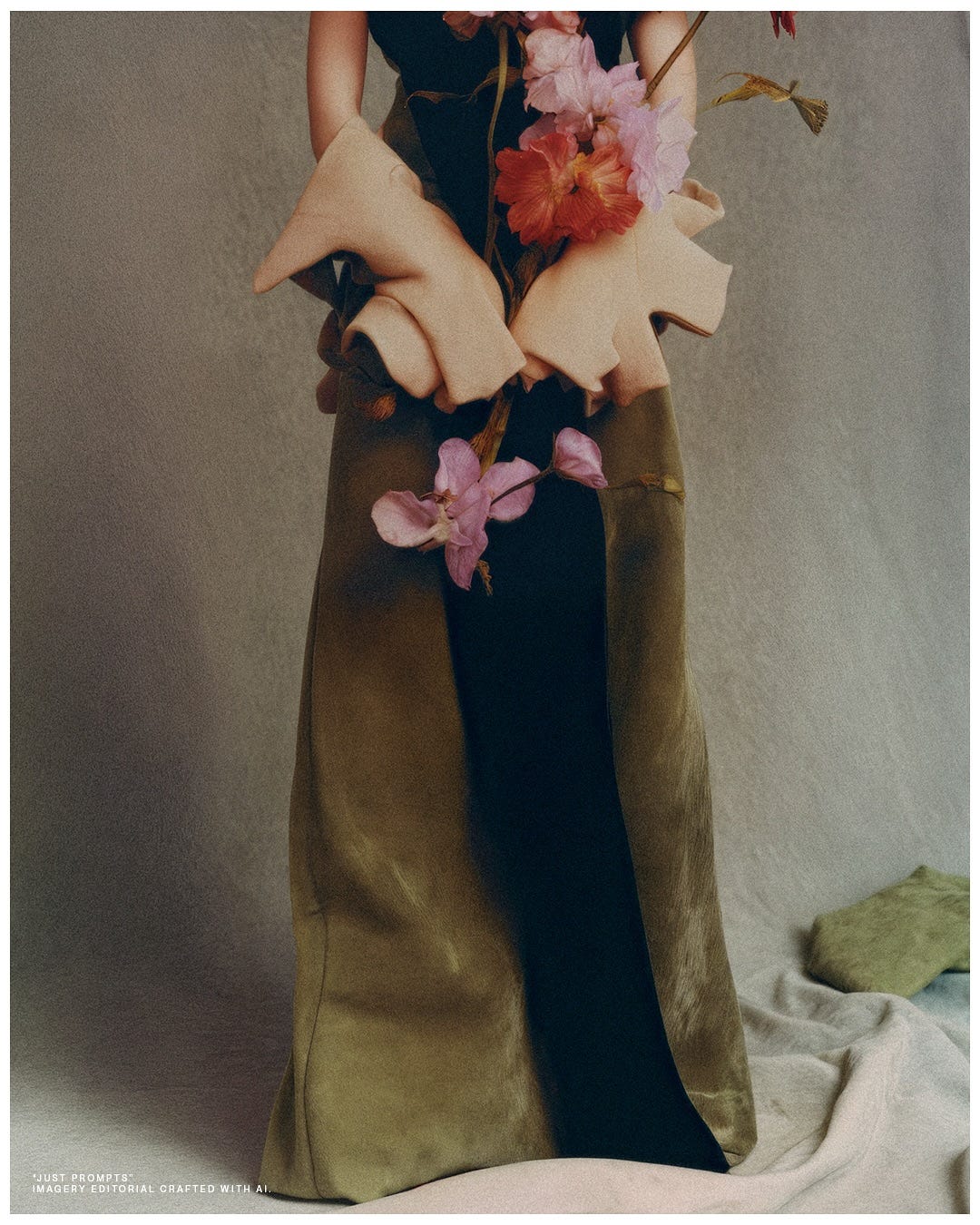


Most revealing is the friction between Romani’s stated philosophy and AI’s actual operations. His photographic ethos depends on the decisive moment, the authentic encounter between lens and subject in urban space. But AI images emerge from statistical aggregations across millions of photographs; they exist in what we might call averaged time, a collapsed temporality that renders street photography’s contingency impossible.
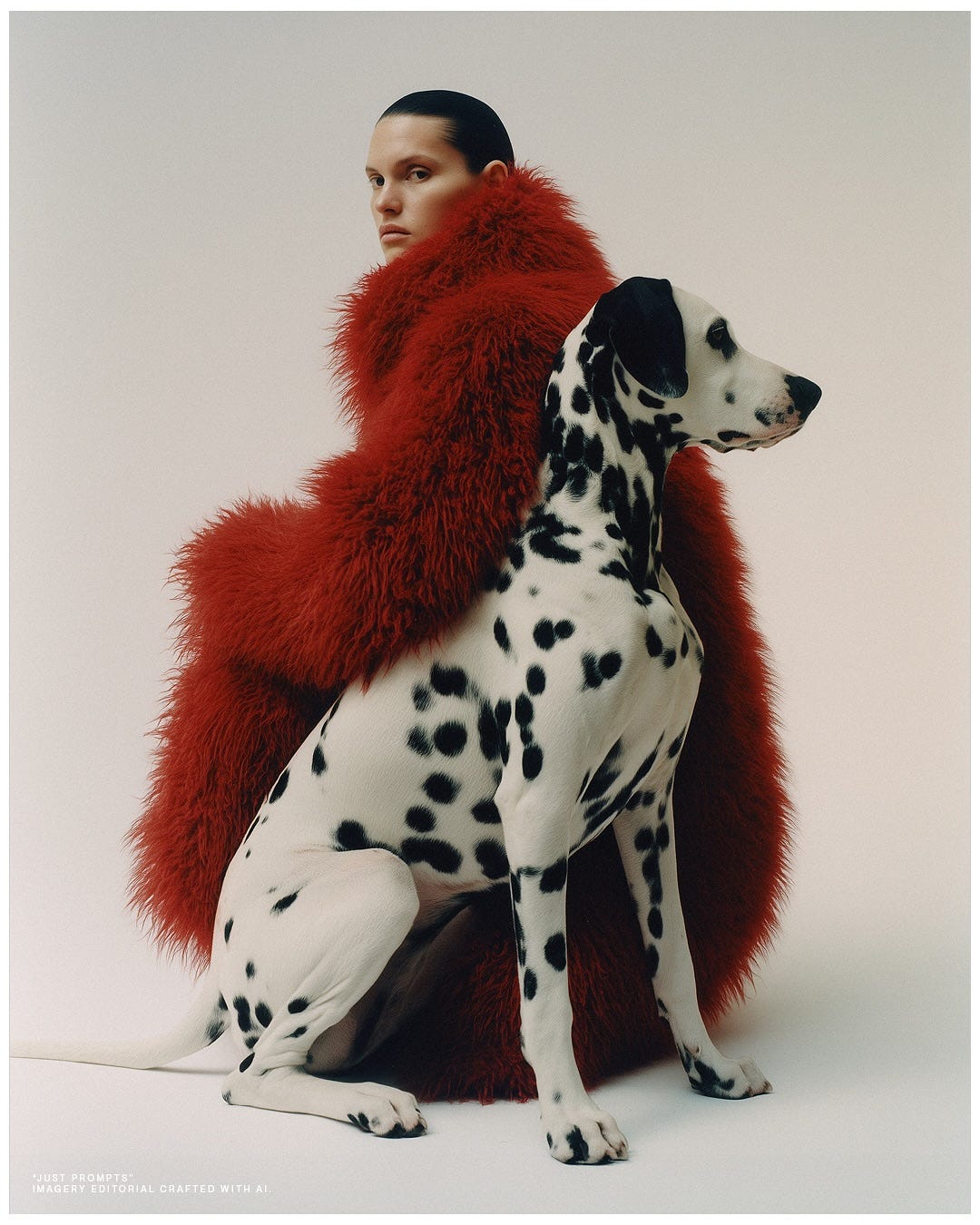
The ice-encased flower and hand-held soccer ball operate as allegories of this condition: preservation through freezing, monumentality through stasis. They suggest AI imagery as fundamentally necrophilic; feeding on photography’s corpus to generate perpetually novel yet essentially derivative forms. The question becomes whether Romani recognizes this productive contradiction or merely reproduces luxury fashion’s existing AI aesthetics.
WHAT’S NEW
Google Teaches AI to See in 4D
Google has unveiled D4RT, a breakthrough AI model that reconstructs full 4D scenes (3D space + time) directly from ordinary video. Unlike previous fragmented pipelines, D4RT unifies depth, motion, and camera tracking in a single system; running up to 300× faster than prior methods. It can track objects even when they leave frame, generate dense 3D point clouds, and estimate camera paths in real time. The tech points toward true “world models,” with major implications for robotics, AR, and spatial computing.
90% Can’t Tell AI Video From Reality, Says Runway
Runway reports that over 90% of people failed to reliably distinguish Gen-4.5 AI videos from real footage in a controlled study of 1,043 participants. Detection accuracy hovered just above chance, with animals and architecture proving especially deceptive. The findings mark a tipping point for synthetic media: realism has outpaced human perception. Runway stresses that detection alone is no longer enough, advocating for provenance standards like C2PA alongside new cultural norms around authenticity as AI video enters mainstream production.
Florence Goes Algorithmic: “Colors” Opens AI Art Exhibition
MathemArt launches “Colors,” an AI-art exhibition running Jan 24–Feb 21 in Florence, presenting 12 AI-generated works organized around red, yellow, green, and blue. Featuring artists WooJeon Park, Alessandro Bellini, Massimiliano Bellini, and Mario Capurro, the show also includes an AI-made film by Andrea Signorini and a special piece by Roberto Pisanelli. Hosted at La Zaffera Gallery, the exhibition explores chromatic experimentation through algorithms; positioning AI as a central artistic medium in a historic cultural setting.
KEY VISUAL
Carlota Seller | @carlotaseller / @insidemaidreams
Carlota Seller’s L’APPEL - THE CALL interrogates the threshold between discipline and desire, between the regimented geometry of ballet and the ambient circulation of fashion’s everyday. Created with the MITO AI tool, this conceptual fashion film traces Repetto Paris back to its balletic origins; not as nostalgic return, but as a meditation on gesture’s afterlife.
What remains when movement leaves the stage? Seller proposes that the ballerina shoe carries within its form a kind of kinetic memory: the rehearsal’s repetition, the body’s training, the lightness that is never natural but always achieved. Through AI-generated sequences, the film suspends these gestures in an aesthetic present tense, where a phone call becomes arabesque, where sitting transforms into performance, where red tights inscribe the body as both subject and sign.
The MITO AI framework allows Seller to work at the intersection of fashion photography’s editorial grammar and cinema’s durational logic. Here, AI doesn’t simulate reality but constructs a parallel space; one where Repetto’s design philosophy (discipline translated into wearability) finds its visual corollary in images that are simultaneously precise and dreamlike, grounded and floating.
Seller’s practice exemplifies how AI expands creative direction beyond representation toward speculation: What if fashion already is choreography? What if every step carries the stage within it?
That’s all for now — we’ll be back in your inbox next week.
Hey, great read as always, I wonder if 'reality optional' enhances or dilutes our understanding of art, you always capture these nuances briliantly.